
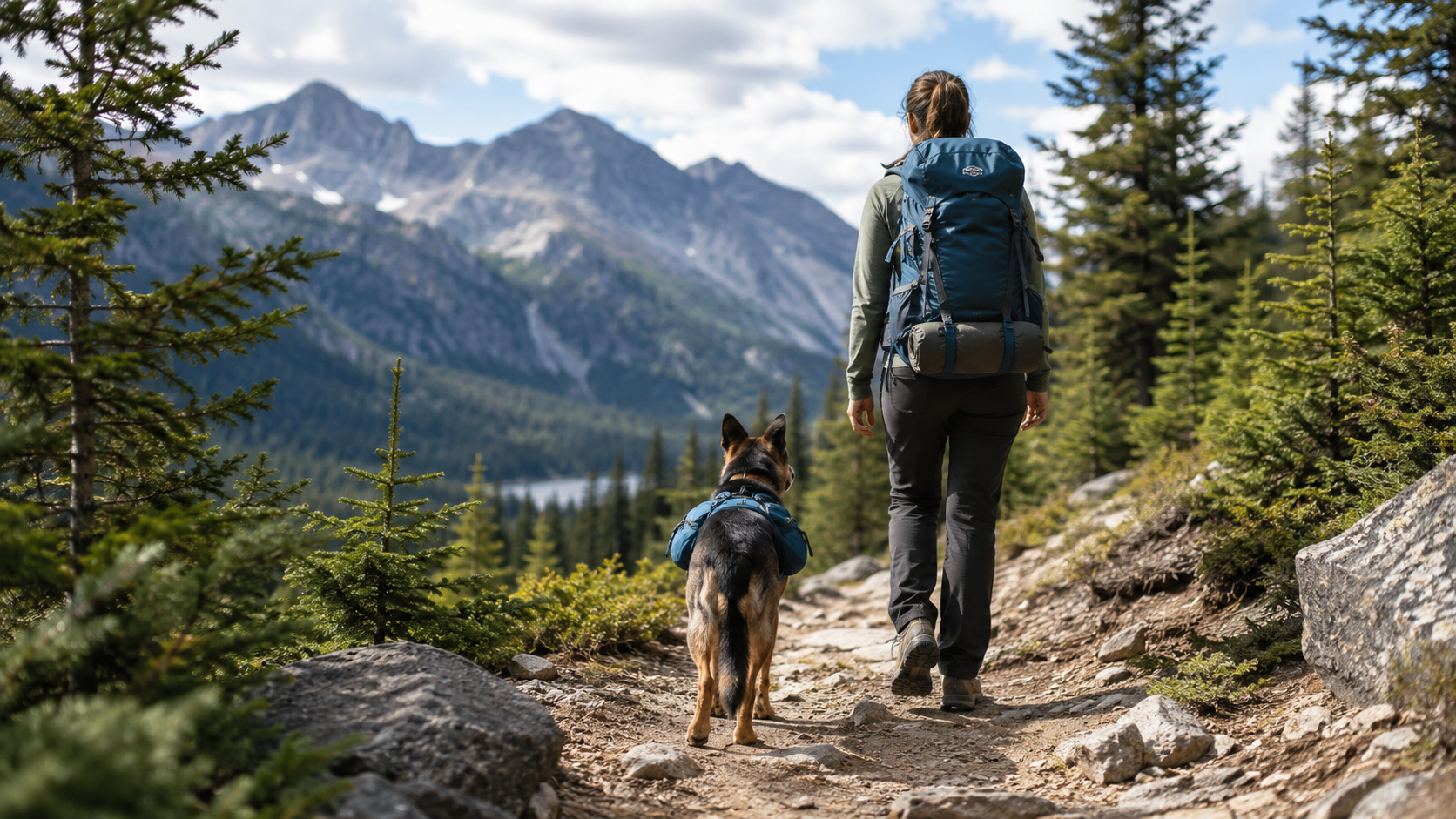
There is a point in every dog-backpacking plan when the idea becomes more serious.
At first, it sounds simple. You already enjoy hiking. Your dog loves being outside. Spending a night or two together on the trail feels like a natural next step. You picture quiet mornings, long miles together and your dog curled up beside you at camp.
Then the practical questions begin.
Can your dog comfortably walk for several days in a row? How will they handle heat, rough ground, unfamiliar sounds and a night away from home? Where will they sleep? How much extra food and water must you carry? What happens if your dog cuts a paw, refuses to eat, reacts to another dog or becomes unable to walk?
Those questions are not reasons to abandon the trip. They are the beginning of responsible planning.
Backpacking with a dog is not the same as bringing one more piece of equipment. Your dog is a living member of the trail team. Route selection, pace, shelter, food, water, equipment, camp routine and emergency decisions must work for both the hiker and the dog.
A successful trip is therefore not built around enthusiasm alone. It is built around a complete system.
This guide provides the planning framework for that system. It will help beginner and early-intermediate hikers understand the major decisions, how the different parts of a dog-backpacking trip affect one another and when a plan needs to change. The supporting guides in this series provide the detailed conditioning plans, route-selection methods, equipment lists, food and water calculations, first-aid guidance and camp procedures.
Every dog is different. Age, breed, physical development, medical history, body condition, temperament, fitness and tolerance for heat or cold can all affect trail safety. Speak with your veterinarian before beginning a new conditioning or backpacking routine, particularly if your dog is young, older, overweight, recovering from an injury or living with a medical condition.
Some links on this page may be affiliate links. If you purchase through these links, MoreHiking may earn a commission at no additional cost to you. We only recommend gear that fits the topic and may genuinely help readers make better trail decisions.
Start With the Central Question: Is This Trip Fair to This Dog?
Many hikers begin by asking, “Can I bring my dog?”
A better question is:
Is this particular trip fair and safe for this particular dog?
That small change in wording matters.
A trail may legally allow dogs and still be a poor choice for yours. An energetic dog may have plenty of excitement but little experience with uneven ground or back-to-back hiking days. A senior dog may still enjoy long walks but struggle with steep descents, cold nights or afternoon heat. A reactive dog may be calm on a familiar local path but overwhelmed by narrow trails, unfamiliar dogs, horses or crowded campsites.
Responsible planning begins by matching the trip to the dog. It does not begin by choosing the trip for yourself and adding the dog afterward.
Think about the hardest part of the proposed route. It may be a long dry stretch, rough rock, a steep descent, an exposed ridge, a busy trailhead, a cold night or a campsite far from an easy exit.
Can you explain how your dog will manage that part?
“I think my dog will be fine” is not yet a plan. A stronger answer includes evidence from previous walks, hikes, training sessions or practice overnights.
Physical strength is only one part of readiness. The dog must also be able to travel under control, accept basic handling, rest during breaks, settle at camp and recover well enough to continue the following day.
The human member of the team must be ready too. You may need to carry the dog’s food, water and equipment, shorten the planned mileage, stop more frequently, manage a leash over difficult ground, pack out waste or abandon the trip when the dog is struggling.
You must also consider what would happen if the dog could no longer walk. A trip that is reasonable for a small dog that can be carried may be much more serious with a large dog on a remote route.
Sometimes the responsible decision is to leave the dog home.
That may be the right choice when the route is too hot, rocky, crowded, remote or physically demanding. It may also be appropriate when the dog is still developing, recovering from injury, poorly conditioned, unable to settle away from home or likely to become overwhelmed by the environment.
Leaving the dog home does not mean that the dog is weak or that the owner has failed. It means the planned trip is not a fair match.
A useful trail-team rule is:
If you cannot explain how your dog will handle the hardest part of the trip, the plan is not ready.

The Trail-Ready Team System: How All the Parts Work Together
Dog backpacking cannot be divided neatly into isolated subjects.
Food affects carried weight. Carried weight affects pace. Pace affects water use. Water availability affects route selection. Route selection affects evacuation options. Camp sleep affects recovery. Recovery affects whether the dog should continue the following morning.
A weakness in one part of the system can quickly create pressure in several others.
Consider a route that is hotter than expected. The dog may need more water, more shade and more frequent rest. The extra water may have to be carried by the hiker, increasing the human load. The dog may need to carry less or nothing at all. Daily mileage may need to fall, which could affect campsite plans and the amount of food required.
If the route has few exits, a manageable temperature change may become a serious planning problem.
Rough terrain creates a different chain of decisions. Sharp rock or abrasive gravel may damage paws. Paw discomfort changes the dog’s gait and pace. A slower pace may leave the team exposed to afternoon heat or approaching darkness. If the dog can no longer walk, the same terrain may make carrying the dog much harder.
Water reliability creates another connection. A stream shown on a map may be dry, stagnant or difficult to reach. If the next dependable source is farther away than expected, the team may need to carry more water, reduce the distance travelled or change campsites.
Behaviour also affects more than trail manners. A reactive dog may require a quieter route, wider trails, less crowded campsites and more distance from other users. A dog that cannot settle at camp may sleep poorly, eat less and begin the next day without adequate recovery.
Even the dog’s size affects the whole system. A large dog may be physically capable on the trail but extremely difficult for one person to evacuate. That may change how remote the route can be, whether the hiker should travel alone and how close the team should remain to an exit.
The same pattern applies to cold, rain, wildlife, poor sleep, equipment failure and unexpected fatigue.
A complete dog-backpacking plan is therefore not ten unrelated checklists. It is one connected decision:
Does this dog, route, hiker, equipment system and emergency plan work together under the expected conditions?
A strong plan also allows for change. Water sources dry up. Temperatures rise. Trails become muddier than expected. A dog may eat less, sleep poorly or develop a sore spot.
A trail-ready team is not one that follows the original plan at any cost. It is one that notices changes early and still has safe options.

Choose a Route That Fits the Dog
A dog-friendly trail is not automatically a dog-suitable trail.
The first step is confirming that dogs are permitted on the trail, at the campsite and in any backcountry areas you plan to enter. Rules can vary by park, trail and season. A location that allows dogs in a developed campground may still prohibit them on wilderness routes.
Once access is confirmed, evaluate whether the route is appropriate for your dog.
Look beyond total distance. Consider elevation, steep descents, exposed sections, trail width, surface, water reliability, expected temperature, wildlife activity, campsite spacing and the availability of shorter alternatives.
Read the route through the dog’s body.
Dogs travel closer to hot ground. They do not use trekking poles on steep descents. They may continue moving from excitement or loyalty even when they need to rest. Fur, body shape, age and fitness can change how they respond to heat, rain and cold.
A line marked as water on a map is not a guarantee. The source may be seasonal, dry, stagnant or difficult for the dog to reach. A campsite may exist but offer little shade, poor sleeping ground or too much nearby activity for a nervous dog.
Exit options matter as much as scenery.
A beginner dog-backpacking route should ideally offer manageable mileage, dependable water, suitable footing, legal access, appropriate campsites and some way to shorten the trip. An out-and-back route, short loop or trip with several exit points may be more responsible than a remote route with no practical alternative.
The goal is not simply to find a trail that allows dogs. It is to choose a dog-friendly backpacking route that fits your particular trail team.
Build Readiness Before the Real Trip
A dog that enjoys long walks is not automatically prepared for multi-day backpacking.
Backpacking requires repeated effort over changing surfaces, with unfamiliar smells, altered meal times, disrupted sleep and possibly new equipment. Excitement may carry a dog through the first day. The second morning often reveals whether the preparation was sufficient.
Readiness should be built gradually.
A sensible progression begins with consistent walking and then adds longer outings, hills, uneven ground, trail distractions and equipment practice. The exact schedule depends on the dog, but the first serious test should not take place on a remote trip.
The dog must adapt physically, but the hiker is also collecting information. Watch how the dog responds to heat, how often they drink, whether they eat after exertion, how their paws handle different surfaces and whether the harness or pack causes rubbing.
The preparation process should eventually include back-to-back hiking days. A dog that performs well on one long outing may still become stiff, tired or reluctant the following morning.
Before a remote multi-day trip, complete a simple shakedown overnight close to home or an easy exit.
The purpose is not to prove that the dog can endure one night outdoors. It is to test the whole trail-team system under low-risk conditions.
Observe whether the dog eats after hiking, drinks normally, settles at camp and sleeps on the planned bedding. Check the paws and equipment contact points. Watch how the dog rises and moves the next morning.
The shakedown also tests the human side. Can you manage the leash, food, water, shelter, waste and sleeping routine without becoming overwhelmed? Did you carry unnecessary equipment? Was anything important missing?
A successful shakedown does not require a perfect night. Its value comes from revealing what needs to change before the consequences are larger.
Do not let the first overnight, first loaded pack, first rough trail and first back-to-back hiking days all happen during the real trip. Take the time to prepare your dog for a multi-day hike through gradual exposure and a controlled readiness test.
Behaviour and Control Are Part of Trail Readiness
Physical fitness does not make a dog trail-ready by itself.
A strong dog can still create an unsafe situation if they pull hard on descents, lunge toward wildlife, rush other hikers, bark through camp or become overwhelmed by unfamiliar dogs.
Trail behaviour does not have to be perfect. It does need to be manageable.
The dog should be able to pause when the hiker pauses, walk under reasonable control, accept basic handling and create space when another trail user approaches. The dog should also be able to rest rather than remaining constantly alert.
Reactivity deserves particular attention. A dog that manages well in a familiar neighbourhood may respond differently on a narrow trail where another dog suddenly appears around a corner. Crowded routes, off-leash areas and busy campsites can place several triggers close together.
The hiker should know how to create distance, communicate with approaching trail users and turn around when the environment is no longer fair to the dog.
Recall is valuable, but it does not replace leash requirements or good judgment. Wildlife, fear and excitement can overwhelm behaviour that appears reliable at home.
These situations require more than basic obedience. They require practical trail manners for hiking with dogs, including safe passing, leash management, realistic recall expectations and a plan for reactive behaviour.
Build the Dog’s Equipment as a System
Dog-backpacking equipment can become a shopping pile very quickly.
Packs, harnesses, bowls, booties, jackets, pads, blankets, lights, towels, trackers and first-aid supplies may all be useful in the right conditions. That does not mean every dog needs every item.
Think in terms of functions rather than products.
The equipment system must provide control, identification, food, water, warmth, sleep, paw protection, waste management, first-aid support and a possible way to move the dog during an emergency.
Fit and testing matter more than owning a long list of equipment.
A pack or harness should not swing, restrict movement or create rubbing. Sleeping equipment must provide enough insulation for the expected conditions. A bowl must be easy to use during short breaks. Booties must be introduced before the trip rather than applied for the first time after a paw begins to hurt.
There is no need to prove that the dog can carry all of their own supplies. A beginner should remain conservative and be prepared for the human to carry most or all of the dog’s food, water and equipment.
Every item should answer a real question:
What problem does it solve, and has it been tested before the trip?
Build a simple system first, then use a complete dog hiking gear checklist for beginner backpackers to identify anything that may have been overlooked.
Protect the Paws Before They Become an Emergency
Paw problems can turn a manageable trip into an evacuation problem.
A dog’s pads may appear tough at home but respond differently to miles of sharp stone, gravel, hot ground, mud, snow or frozen crust. A torn pad, cracked nail or raw spot may quickly change how far the team can travel.
Paw protection begins before the trip.
Gradual exposure to realistic trail surfaces helps the hiker learn what the dog tolerates. The objective is not to toughen the paws by pushing through damage. It is to build experience while preventing small problems from becoming injuries.
Different surfaces create different risks. Sharp rock may cut or abrade. Hot surfaces can burn. Mud may hide debris or soften pads. Snow and ice can collect between toes. Seeds and plant material can become lodged in the coat or paw.
Booties may be useful in some conditions, but they require practice. A dog that has never worn them may change their gait, refuse to walk or develop rubbing. Protective products are not a substitute for choosing suitable terrain and checking the paws regularly.
Build paw checks into normal trail breaks.
Look at the pads, between the toes, around the nails and along the edges where small problems can hide. Notice repeated licking, a shortened stride, reluctance to continue or a sudden change in pace.
The goal is early recognition.
A mild irritation discovered during a break may allow the team to rest, adjust equipment or turn around while the dog can still walk comfortably. If an injury has already occurred, the situation moves from prevention into first-aid and evacuation planning.
Plan Food and Water Around the Real Trip
Food and water planning must be based on the actual dog, route and conditions.
A dog may use more energy while backpacking than during an ordinary day at home, but the increase is not identical for every dog or trip. Cool forest travel, hot exposed terrain, steep climbing and easy low-mileage routes create different demands.
The pillar-level rule is to avoid surprises.
Test the planned food before departure. Learn whether the dog eats normally after a tiring hike. Do not rely on an unfamiliar food, treat or feeding routine for the first time in the backcountry.
Some dogs eat eagerly after exercise. Others become too tired, distracted or stressed to eat normally. That is important information because food refusal on the first evening may affect the following day.
Water planning must account for both quantity and reliability.
Do not assume every mapped stream will be flowing or safely accessible. Carry enough water to reach the next dependable source and have a backup plan for dry stretches. Offer the dog regular opportunities to drink rather than waiting until the dog appears desperate.
Natural water should not automatically be treated as safe. Stagnant water, livestock contamination and harmful algae can create risks. When the quality is uncertain, use the same caution you would use for your own drinking water.
The detailed calculations belong in a separate guide. The essential questions are whether the food has been tested, whether the dog will eat after exertion, where dependable water is located, who will carry it and what happens if a planned source is unavailable.
Before finalizing the trip, calculate how much food and water your dog needs for backpacking under the expected mileage, weather and terrain.
First Aid, Turnaround Decisions and Evacuation Readiness
A canine first-aid kit is important, but equipment does not make decisions.
The difficult part is deciding whether the dog should continue, rest, turn around or receive urgent veterinary care.
Trail first aid is temporary support. Its purpose is to prevent a situation from becoming worse while the hiker begins an exit or seeks professional care.
The plan should include conservative turnaround criteria before the trip begins.
Continued limping, inability to bear weight, repeated vomiting, serious bleeding, unusual weakness, breathing difficulty, confusion, collapse or signs of dangerous overheating are reasons to stop and reassess immediately rather than pushing forward with the trip. Some signs—particularly breathing difficulty, collapse, severe bleeding, marked confusion or suspected heatstroke—may require urgent veterinary care.
The more remote the route, the more important the exit plan becomes.
Every dog-backpacking hiker should answer this question before leaving:
Could I move my dog if they could not walk?
For a small dog, the answer may involve carrying the dog in an appropriate bag or sling. For a large dog, the challenge may require a rescue harness, a second person or a route close enough to assistance.
The answer affects whether you hike alone, how remote the route can be, how far the team travels from an exit and whether communication equipment is needed.
Do not assume that owning a rescue sling solves the problem. You must know how it fits, how the dog responds to being lifted and whether you can actually move the combined weight over the expected terrain.
A route is not appropriate simply because the dog can walk into it. The team must also have a realistic plan for getting out.
Carry appropriate supplies, understand their limits and review the complete guide to canine first aid for hiking before leaving for a remote trip.
Camp Is a Second Test, Not Just a Place to Sleep
Many beginners focus almost entirely on the walking part of dog backpacking.
Camp introduces a different set of challenges.
The dog may arrive tired but overstimulated. New smells, food, wildlife, other campers and unfamiliar shelter materials can make it difficult to relax. A dog that travelled calmly all day may still pace, bark or resist entering the shelter.
The sleeping system must provide control, protection from weather and enough comfort for recovery.
The exact arrangement depends on the dog, shelter, temperature, wildlife risk and local regulations. Some dogs sleep inside the tent. Others may use a vestibule or another close, controlled space when conditions allow.
Whatever system is selected, practise it before a remote trip.
Let the dog learn where to lie down. Test the pad or blanket. Consider wet paws, claws, cold ground, ventilation and the possibility of a restless dog stepping on fragile equipment.
Camp sleep is not only about comfort. It affects the dog’s ability to recover for the next day.
A dog that does not eat, drink, settle or sleep should be reassessed in the morning rather than automatically expected to continue.
A detailed guide to camping with a dog can help you build and practise the sleeping system, tent setup and nighttime routine before the real trip.
Waste Is a Multi-Day Logistics Problem
Dog waste remains the owner’s responsibility throughout the trip.
On a short hike, the solution is usually straightforward: bag it and carry it to an appropriate disposal point.
A multi-day trip may require carrying waste for much longer. That is unpleasant, but it does not make leaving a bag beside the trail acceptable.
Choose a carrying system before the trip. It must control odour, prevent leaks and remain separate from food and clean equipment. The system should also be easy enough to use that it does not become an excuse for leaving waste behind.
Local regulations may affect how waste must be handled, particularly in sensitive environments. Confirm the rules for the area rather than assuming that one method is acceptable everywhere.
A complete plan for dog waste on the trail should account for bagging, carrying, odour control, disposal and the number of days the team will be away from a trash container.
Responsible Trail Use Is About More Than Controlling the Dog
Managing the dog is only half of trail responsibility. The hiker must also manage the team’s effect on other people, animals and the environment.
Another hiker may be frightened of dogs. Another dog may be unfriendly or recovering from an injury. Horses and pack animals can be startled. Wildlife can be disturbed even when a dog never makes physical contact.
A friendly dog is not automatically welcome to approach.
The responsible hiker follows local leash rules, creates space, communicates during encounters and prevents the dog from entering another person’s campsite or rest area.
Good etiquette also includes controlling noise, protecting water sources, respecting wildlife closures and keeping the dog away from sensitive vegetation.
These decisions help protect other visitors and continued trail access for dog owners.
A good trail dog is not simply loved. A good trail dog is managed by a thoughtful hiker who understands dog trail etiquette for beginner hikers.
Use a Morning, Midday and Camp Check-In Rhythm
A daily check-in rhythm helps the hiker notice small changes before they become major problems.
These checks do not need to feel clinical. They are short moments of observation built into the normal flow of the day.
Morning check
Watch the dog rise and move before putting on the harness or pack.
Morning stiffness, limping or reluctance to move may reveal soreness that was not obvious while the dog was excited the previous day. Check appetite, drinking, paws and any areas under the harness.
Consider the dog’s mood as well. A tired dog may still follow because the hiker is preparing to leave. Willingness to follow is not always the same as physical readiness.
The morning check should end with a decision:
Is today’s distance still fair, or should the team shorten the route, remain in camp or begin the exit?
Midday check
Do not wait until the dog stops moving.
Notice changes in pace, breathing, posture and attention. Offer water and shade. Inspect the paws and equipment contact points. Look for rubbing under the chest, behind the front legs and wherever straps touch the body.
This is also the time to reconsider the plan. If the team is moving more slowly, using more water or encountering hotter conditions, the original campsite may no longer be the right objective.
A midday adjustment is usually easier than an evening emergency.
Camp check
Once movement stops, observe how the dog recovers.
Does the dog drink? Will they eat? Can they settle? Are there ticks, burrs, sore spots or areas of rubbing? Is the sleeping space dry and appropriate?
The camp check should include what happened during the day, not only what the dog looks like at that moment. Consider the distance travelled, heat exposure, water use, behaviour and any changes in gait.
Then ask:
Based on what happened today, is tomorrow’s plan still fair to this dog?
That question keeps the trip centred on the dog’s actual condition rather than the hiker’s original expectations.

Recovery Is Part of Planning the Next Trip
The trip is not over when the team reaches the trailhead.
Some problems become clearer after the excitement fades. A dog that seemed comfortable while moving may show stiffness later. Paw irritation, appetite changes or unusual fatigue may appear after returning home.
Complete a calm post-hike inspection and continue watching the dog during the recovery period. Seek veterinary advice when symptoms are significant, unusual or persistent.
Recovery also provides valuable planning information.
Record how much mileage was comfortable, whether the dog drank and ate normally, how the paws handled the terrain and whether the equipment fit correctly.
Consider camp behaviour and sleep. How did the dog respond when tired? How long did full recovery take? What equipment was unnecessary? What was missing?
These notes are not busywork.
They are how a general dog-backpacking plan becomes a reliable plan for your individual dog.
A trail-ready team is not created in one trip. It develops through observation, adjustment and honest decisions. A complete post-hike dog recovery process helps you identify hidden problems and prepare more accurately for the next outing.
Coming Soon: Paws on the Path
A practical offline field guide for hiking and backpacking with dogs, including planning tools, daily check-ins, camp routines and emergency decision prompts for use away from cell service.
Use the MoreHiking guides to prepare at home. Carry the field guide when the trail gets real.
Conclusion: Your Dog Needs a Prepared Partner
Backpacking with a dog can be one of the most rewarding ways to experience the outdoors.
It can also become difficult quickly when the dog is added to the trip instead of built into the plan.
The difference is not how much you love your dog. The difference is whether you are willing to plan for the less exciting parts before they matter.
Rules, heat, water, terrain, food, paws, equipment, camp behaviour, waste, emergency movement and recovery are not separate concerns. Together, they form the system that protects the trip.
The goal is not to prove that your dog can endure anything.
The goal is to choose a route your dog can handle well, prepare before the trip and pay attention closely enough to change the plan when needed.
Your dog does not need a perfect trip.
Your dog needs a prepared partner.
That is what turns a hiker and a dog into a trail-ready team.
Frequently Asked Questions
What makes backpacking with a dog different from a day hike?
Backpacking requires the dog to repeat the effort over several days while also adjusting to unfamiliar sleeping arrangements, different feeding times, camp activity and changing conditions.
A dog that comfortably completes one day hike may still struggle to eat, settle, recover or walk normally the following morning. The trip must therefore account for recovery, sleep, overnight warmth, food, water, waste and emergency movement—not only the first day’s mileage.
How do I know whether a particular trip is fair to my dog?
Evaluate the complete match between the dog and the trip.
Consider the dog’s health, age, conditioning, behaviour, paw experience and ability to settle away from home. Then compare those abilities with the hardest parts of the route, including heat, rough terrain, long dry sections, crowded trails and remote campsites.
The plan is not ready until you can explain how the dog will manage the hardest expected condition and what you will do if the dog begins to struggle.
Should my dog complete a shakedown overnight before a multi-day trip?
Yes. A short overnight close to an easy exit is one of the best ways to test the complete trail-team system.
It can reveal whether the dog eats after exertion, drinks normally, settles at camp, sleeps on the planned bedding and moves comfortably the following morning. It also tests whether the hiker can manage the equipment, leash, food, water, shelter and waste routines.
The pillar establishes the shakedown as an important readiness gate. A separate MoreHiking preparation guide will provide the detailed progression and evaluation process.
What is the most important emergency question to answer?
Ask:
The answer affects route distance, remoteness, partner selection, communication equipment and whether an emergency carry system is needed.
Do not rely on an untested rescue sling or assume another hiker will be available. Remain honest about the dog’s weight, the terrain and your physical ability.
When should I leave my dog home?
Leave the dog home when the route, conditions or environment are not a fair match.
This may include extreme heat, rough terrain, long dry stretches, technical obstacles, heavy wildlife activity, crowded routes or locations with poor exit options.
A dog that is injured, unconditioned, medically vulnerable, highly reactive or unable to settle at camp may also be better served by staying home.
Leaving the dog home can be a responsible trail decision rather than a failure.
What should I monitor during each day of a multi-day trip?
Check the dog in the morning, during the hiking day and again at camp.
Watch movement, appetite, hydration, paws, breathing, pace, equipment fit, mood and ability to settle. Changes in these areas may indicate that mileage, load, rest time or the entire plan needs to change.
The most important daily question is:
Does my dog need to carry a backpack?
No. A dog does not need to carry equipment to be part of a backpacking trip.
Whether a dog should carry anything depends on the individual dog, conditioning, equipment fit, weather, terrain and professional guidance. In many cases, especially for beginner teams, the hiker should expect to carry most or all of the dog’s food, water and equipment.
The goal is not to divide the weight equally. The goal is to protect the dog’s movement, comfort and safety.
Leave a Reply