
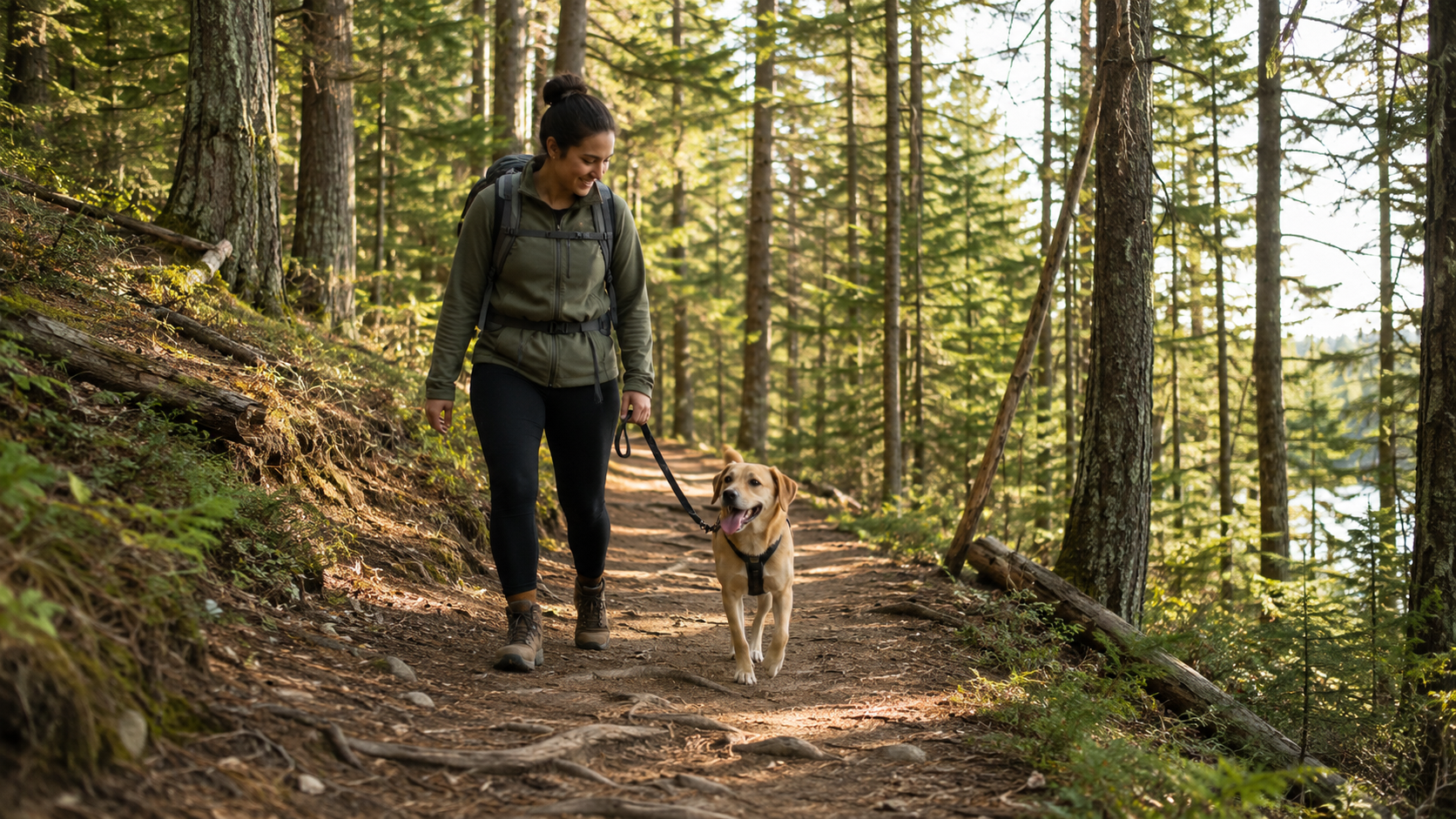
A dog that enjoys ordinary walks or occasional hikes is not automatically prepared for several days on the trail. A multi-day hike asks the dog to travel over natural terrain, recover after each outing, and begin moving comfortably again the following morning.
To prepare your dog for a multi-day hike, begin with the dog’s current health and activity level. Establish what the dog can already do comfortably, increase the physical demands gradually, introduce consecutive hiking days, and complete a realistic readiness test before committing to the trip.
The goal is not to push the dog until it reaches your planned distance. It is to build enough fitness that the dog can participate safely, willingly, and repeatedly.
One hard hike does not prove multi-day readiness. A dog may finish a difficult day through excitement and determination but still be unable to repeat that effort comfortably the next morning.
Begin With Your Dog’s Health and Present Ability
Start with the dog you have today rather than the dog you hope to have by departure day.
Consider the dog’s age, body condition, health history, mobility, and normal activity. A dog that already completes moderate day hikes has a different starting point from one whose exercise consists mainly of short neighbo
rhood walks.
Also consider what happens after exercise. A dog may appear enthusiastic at the beginning of a walk but slow considerably later, move stiffly that evening, or hesitate when rising the next morning. Those observations matter as much as the distance completed.
It is sensible to consult your veterinarian before beginning strenuous conditioning, especially when the proposed activity is a large increase from the dog’s normal routine. A veterinarian can help evaluate your dog’s starting fitness, body condition, heart and lung health, and any pain, metabolic, or musculoskeletal issues that could affect strenuous activity.
Veterinary input is particularly important when a dog is older, overweight, short-muzzled, recovering from an injury, taking medication, or living with an existing heart, breathing, metabolic, or musculoskeletal condition. Individual health and structure are more useful than a breed’s general reputation for being energetic.
Puppies and Growing Dogs
A puppy’s enthusiasm can be misleading. A young dog may seem willing to run for a long time even though its developing body is not ready for repeated strenuous hiking.
Growing dogs should not be pushed into repeated strenuous hiking before they are physically mature enough for it. Growth plates are still developing during puppyhood and can be vulnerable to excessive physical loads. Because the timing of maturity varies with the dog’s size and development, veterinary guidance is more reliable than applying one universal age rule.
Appropriate walks, play, socialization, and gentle trail exposure can still be valuable. The objective is to build confidence and movement skills without turning a growing dog’s energy into forced endurance training.
Older Dogs and Dogs With Health Concerns
Age alone does not automatically disqualify a dog from hiking. Some older dogs remain active and capable, while some younger dogs have physical limitations.
The important question is whether the dog can perform the required work comfortably and recover from it. An older dog may need shorter hiking days, easier terrain, more time between training sessions, or a different trip altogether.
Sudden changes in mobility, stamina, breathing, posture, or willingness to exercise deserve veterinary attention rather than a more aggressive conditioning plan.
Establish Your Dog’s Current Hiking Baseline
Your dog’s baseline is the amount and type of activity it can complete comfortably and recover from normally.
Begin with familiar walks or easy trails. Observe the dog’s gait, pace, willingness to continue, breathing, and behavior. Then check how the dog moves and behaves later that day and the following morning.
Do not base the baseline on one unusually good outing. Look for a level of activity the dog can repeat without unusual fatigue, stiffness, reluctance, or changes in movement.
Record a few simple details after each outing:
- How long the dog was active.
- What type of ground it covered.
- Whether hills were involved.
- When the dog began to slow.
- How the dog behaved later that day.
- How the dog moved the following morning.
The purpose is not to create a complicated training spreadsheet. It is to identify the dog’s dependable starting point.
A baseline may be thirty minutes of steady walking, an hour on an easy trail, or a moderate half-day hike. Whatever it is, conditioning should begin there rather than at the mileage planned for the future trip.
Build Endurance Gradually
Conditioning gives the dog’s muscles, tendons, joints, cardiovascular system, and other body systems time to adapt to increasing physical demands. Veterinary sports-medicine research explains that tissues remodel in response to training loads, but that process takes time. Training can also improve how the body responds to exercise and recovers afterward.
Consistency is generally more useful than occasional exhaustion. Regular, manageable exercise provides a better foundation than remaining relatively inactive and attempting one very long outing. A slow, steady increase in exercise duration and intensity is also more comfortable and may reduce the likelihood of injury.
Increase one major demand at a time. For example, extend the duration while keeping the terrain easy. Once the dog handles that comfortably, introduce modest hills or uneven ground.
Avoid increasing distance, elevation, pace, terrain difficulty, heat exposure, and carried equipment all at once. When several demands change together, it becomes difficult to determine what caused the dog to struggle.
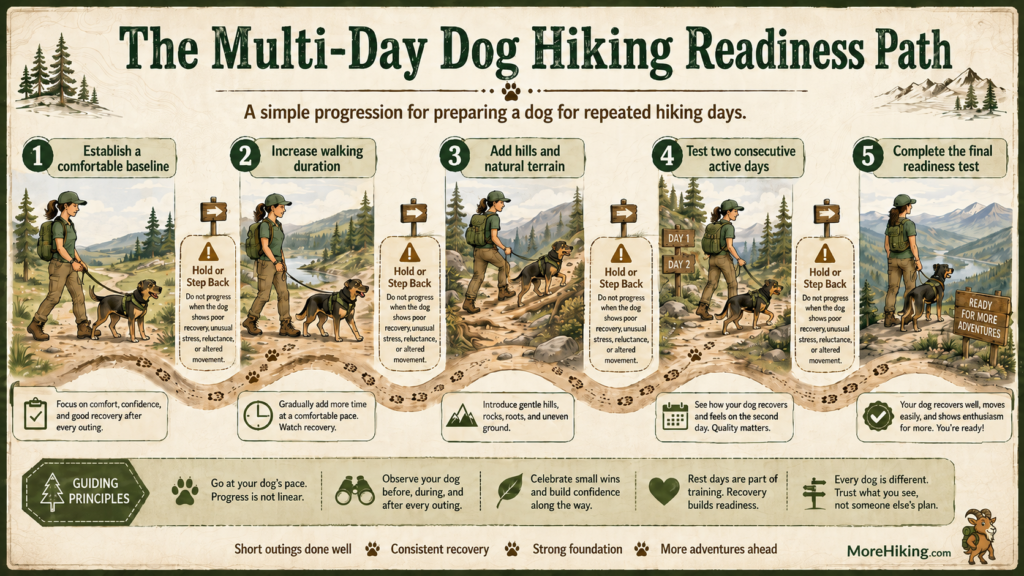
A Flexible Conditioning Progression
| Stage | What to Do | Ready to Progress When |
|---|---|---|
| Establish a baseline | Repeat familiar walks or easy outings regularly. | The dog completes them comfortably and behaves normally afterward. |
| Increase duration | Add time gradually while keeping the terrain easy. | The longer outing no longer causes poor recovery. |
| Add trail difficulty | Introduce modest hills and short sections of uneven terrain. | The dog maintains normal movement, balance, and confidence. |
| Add consecutive days | Follow one suitable outing with an easier second-day outing. | The dog begins the second day willingly and recovers normally. |
| Complete a readiness test | Conservatively reproduce the intended physical demands. | The dog completes both days without a significant physical decline. |
On a mobile device, swipe left or right to view the full table.
This progression is not a fixed calendar. A dog may remain at one stage for several weeks or need to return to an easier stage after illness, inactivity, soreness, or a long break from training.
Add Hills and Uneven Terrain Carefully
Distance is only one part of trail difficulty. Hills, roots, rocks, loose surfaces, mud, and repeated stepping over obstacles place different demands on the dog’s body.
Uphill travel increases effort. Descending requires control and may challenge different muscle groups. Uneven ground requires balance and repeated adjustments. A dog may therefore tire sooner on a natural trail than during a walk of similar length on smooth ground.
Introduce modest terrain changes only after the dog handles the current walking duration comfortably. Begin with short hills and manageable natural surfaces rather than selecting a difficult trail simply to discover the dog’s limit.
Training should end while the dog still has useful capacity. The objective is adaptation, not exhaustion.
The eventual backpacking route must also match the dog’s demonstrated ability. Trail regulations, water availability, weather exposure, terrain difficulty, and exit options belong in How to Choose a Dog-Friendly Backpacking Route: Rules, Terrain, Water, Weather, and Exit Options.
Train for Consecutive Hiking Days
Consecutive-day training is what separates preparation for a multi-day hike from ordinary day-hike conditioning.
A conservative back-to-back test is a useful MoreHiking readiness method because the planned trip itself requires repeated days of activity. It is not a universal veterinary test or a guarantee that the dog will complete the trip safely.
A dog may complete one demanding hike through excitement and determination but still be unable to repeat that effort comfortably the next day. One successful outing does not prove multi-day readiness.
After the dog has developed a foundation of regular longer walks and hikes, schedule two active days close together. Make the second outing shorter and easier at first.
The purpose of the second outing is to observe how the dog responds before receiving several full days of recovery. It is not intended to duplicate the complete trip immediately.
Pay attention to how willingly the dog begins the second outing. Compare its gait, pace, coordination, posture, and interest with the previous day. Stiffness, hesitation, unusual slowness, or reluctance to continue suggests that the first outing may have exceeded the dog’s current capacity.
Repeat this process gradually. As the dog adapts, the two outings can become more similar. They do not need to become two maximum-effort days.
The finish line is repeatable ability. The dog should be able to complete suitable work and then move comfortably again the next day.
Use Recovery as a Readiness Measurement
Conditioning does not end when the hike ends. The dog’s condition during the following hours and the next morning helps determine whether the workload was appropriate.
Stop and allow the dog to rest if it appears out of breath or repeatedly tries to sit or lie down. Hold off on further exercise and contact your veterinarian if the dog later responds unusually slowly, seems irritable, has difficulty lying down or getting up, or develops an abnormal posture.
Heat requires special caution. Early signs that a dog may be overheating include heavy panting, seeking shade, whining, reluctance to continue, and drooling. Difficulty breathing, bloody diarrhea, vomiting, weakness, confusion, seizures, or collapse can indicate heatstroke and require immediate veterinary care.
For conditioning purposes, the central question is whether the dog returns to its usual movement, behavior, and willingness to be active before the next planned exercise session.
When recovery is poor, do not increase the next outing. Repeat an easier workload, allow more rest, or obtain veterinary advice.
Complete a Realistic Readiness Test
The final test should reasonably resemble the physical demands of the planned trip without reproducing every difficult feature at once.
Choose a safe route with enough walking time and terrain variety to make the test meaningful. It should also provide a practical way to turn around or finish early.
Follow the first outing with another suitable outing the next day. The second day does not need to match the proposed trip’s maximum mileage. It must be demanding enough to show whether the dog can move comfortably and willingly before receiving several days of rest.
During the test, look for:
- A reasonably steady gait.
- Continued willingness to move.
- Comfortable settling after the outing.
- Normal movement later that day.
- A willing and comfortable start to the second day.
- Normal recovery after both outings.
Eating and drinking should still be monitored during any hike, but they should not be presented as proof that the dog is physically prepared for a multi-day trip. Detailed food quantities, water requirements, carrying plans, and feeding schedules belong in How Much Food and Water Does a Dog Need for Backpacking?
Do not treat one readiness test as a guarantee. Use it as practical evidence that the proposed workload may be reasonable for this dog.
Make the Final Readiness Decision
After the readiness test, choose the outcome that best matches the evidence.
Proceed
Proceed when the dog consistently handles comparable activity, starts the second day willingly, recovers normally, and has no unresolved health or movement concerns.
Modify the Trip
Modify the trip when the dog is generally capable but would be better served by shorter hiking days, easier terrain, less elevation, additional rest, or a simpler route.
Modification is appropriate when the dog has demonstrated useful ability but the original plan asks for more than the dog has comfortably shown.
Continue Conditioning and Postpone
Postpone when the dog is making progress but has not yet demonstrated comfortable consecutive-day endurance.
Postponing does not erase the conditioning already completed. It gives the dog more time to develop the ability required by the trip.
Leave the Dog Home
Leave the dog home when the trip exceeds the dog’s reasonable physical ability, health concerns create unacceptable risk, or the dog repeatedly appears uncomfortable or unwilling during preparation.
Leaving your dog home is not a failed preparation plan. It may be the decision that best protects your dog while allowing you to complete a trip that is not suitable for that particular trail partner.
Complete the Other Backpacking Systems
Physical readiness is only one part of taking a dog on a multi-day hike. Route selection, equipment, food and water, first aid, camping, trail conduct, and recovery each require their own preparation.
When the dog begins wearing its planned trail equipment during later conditioning hikes, follow the fitting, load, and equipment-testing guidance in Dog Backpacking Gear System: Pack Fitting, Trail Tech, and What Your Dog Should Carry. The article is already published on MoreHiking.
The complete planning system will be brought together in The Trail-Ready Team: A Complete Guide to Logistics, Safety, and Multi-Day Backpacking With Dogs.
The job of this article is narrower: determine whether the dog’s body is prepared to perform the work on more than one day.
Frequently Asked Questions
These answers cover common questions about conditioning and deciding whether a dog is physically ready for repeated hiking days.
How long does it take to prepare a dog for a multi-day hike?
There is no universal number of weeks. A healthy adult dog that already hikes regularly may progress faster than a sedentary dog or one with little experience on natural terrain. Plan in weeks rather than days, and let the dog’s performance and recovery determine the pace.
Should my dog complete hikes on consecutive days before the trip?
A conservative back-to-back test is useful because a multi-day trip requires repeated days of activity. Begin with a manageable first outing followed by a shorter, easier second day. This is a practical readiness check rather than a universal veterinary requirement.
Can an older dog prepare for a multi-day hike?
Possibly. Age alone does not provide the answer. Health, mobility, previous conditioning, recovery, and trip difficulty all matter. Obtain veterinary guidance before substantially increasing activity for an older dog.
Can a puppy go on a multi-day hike?
Growing dogs should not be pushed through repeated strenuous hiking before their bodies are physically mature enough. Because maturity varies by the dog’s size and development, discuss the proposed activity with a veterinarian rather than relying on one universal age cutoff.
What signs suggest my dog is not ready?
Persistent stiffness, an altered posture or gait, poor next-day recovery, repeated reluctance, unusual exhaustion, or a clear decline during the second training day suggest that the workload should be reduced and the plan reassessed. Persistent or concerning symptoms should be discussed with a veterinarian.


Leave a Reply