
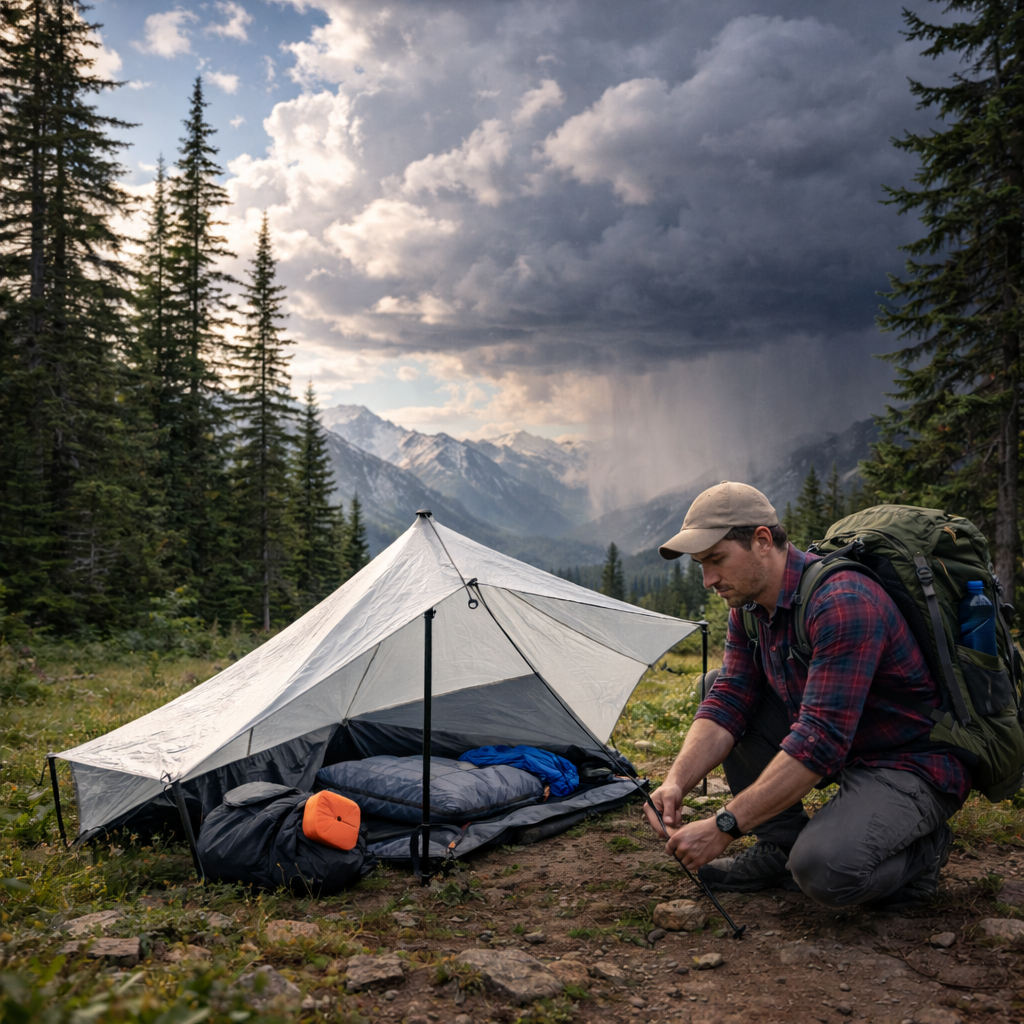
Somewhere late in the afternoon, the trail smooths out. Your breathing evens. The pack on your back finally feels like part of you instead of something you’re carrying. You’re not rushing, not bracing, not calculating every step. You’re just hiking.
That feeling is what draws many people toward becoming minimalist backpackers in the first place. Less weight. Less friction. More awareness of where you are.
Shelter is often the hardest piece to simplify—not because it isn’t important, but because it has to perform across real, changing conditions. Weather shifts. Forecasts carry uncertainty. Nights last longer than expected. It’s natural to want a shelter that can handle anything.
At the same time, carrying unnecessary bulk on clear, stable trips quietly erodes the freedom that minimalist hiking promises.
A scalable backpacking shelter system offers a way forward. It allows you to hike light under blue skies and still feel prepared when conditions evolve, without packing for extremes that may never arrive.
This article contains affiliate links. If you purchase through these links, MoreHiking may earn a commission at no additional cost to you. We only recommend gear we trust and have carefully researched.
Why weight and confidence both matter in a scalable shelter system
Minimalist backpackers care about weight for tangible reasons. Lighter packs reduce fatigue, improve balance, and allow for longer, more comfortable days on the trail. Weight also affects how quickly you can set up camp and how much energy you have left to enjoy it.
Confidence matters just as much. Confidence that your shelter will keep you dry. Confidence that it can handle wind and shifting weather. Confidence that your choices are grounded in experience rather than worry.
In practice, weight and confidence reinforce each other. When your shelter system is intentionally designed, you stop second-guessing it. You know why each piece is there and when it’s meant to be used. This alignment is a defining principle of ultralight backpacking systems, where gear is chosen for adaptability rather than maximum coverage in every scenario.
What a scalable backpacking shelter system really means
A scalable shelter system is not a single product. It’s a layered approach to protection.
Every overnight shelter—tent, tarp, bivy, or poncho—serves the same basic functions: overhead rain protection, wind management, separation from the ground, and some form of bug control. Once you understand those roles, shelter decisions become modular rather than binary. That’s why we approach our shelter category on MoreHiking.com as a spectrum of solutions rather than a single answer, drawing from a range of tarp, tent, and emergency shelter strategies depending on terrain, season, and skill level.
Instead of packing one structure designed for worst-case weather on every trip, you assemble only the protection needed for the conditions you expect, with the ability to add targeted margin when appropriate. If you’re not familiar with how forecasts present data, it’s worth reviewing a basic guide from the National Weather Service before heading out on the trail.
This philosophy closely aligns with the shelter systems described by experienced long-distance hikers and educators such as Andrew Skurka, who emphasizes adaptable tarp-based systems that respond to terrain, forecast confidence, and skill level rather than fear-based packing.
Best way: a flat tarp shelter system that scales with conditions
For most minimalist backpackers, the most adaptable and time-tested foundation is a flat tarp shelter system paired with a lightweight groundsheet.
Flat tarps are widely regarded as one of the most versatile lightweight shelter options available. Outdoor publications and experienced hikers consistently note that tarps can be pitched in multiple configurations, allowing them to respond to calm conditions, heavy rain, or shifting winds with minimal adjustment.
A flat tarp can be set high and open on warm, still nights, encouraging airflow and comfort. When weather changes, it can be lowered, angled, or reshaped to shed rain and block wind. The groundsheet protects against moisture and abrasion without adding bulk.
Have you ever considered ultra light options for your groundsheet, we see this as one the most important pieces of gear in your pack? Your tent keeps the rain off your head, but your groundsheet keeps the life-extinguishing cold of the earth away from your core.
Optional layers—such as a breathable bivy or bug net—can be added when conditions call for them rather than carried automatically. This modularity is what makes the flat tarp such a strong base for a scalable shelter system.
Over time, hikers using this approach develop practical skills: reading wind direction, selecting sheltered campsites, and adjusting pitch geometry. These skills replace unnecessary gear and build confidence naturally. As many Backpacking Light contributors point out, tarp systems reward experience but remain reliable when used intentionally.
Staying Dry Under a Tarp
When you use a floorless tent, you have to worry about “splash-back.” This happens when rain hits the dirt and bounces up under your tarp.
- Pick the Right Spot: Look for a bed of pine needles. They drain water better than flat dirt or grass.
- The “Drip Line” Rule: Make sure your ground sheet doesn’t stick out past your tarp. If it does, it will catch the rain and funnel a puddle right under your butt.
- Control the Air: Good airflow stops “tent rain” (condensation). Check out our guide on [How to Stop Tent Condensation] for more on this.
A strong alternative: combining a poncho-tarp with a breathable bivy
Some minimalist backpackers place an even higher value on multi-use efficiency. For them, a poncho-tarp combined with a breathable bivy offers a compelling alternative.
In this system, the poncho functions as rain protection while hiking and becomes the primary overhead shelter in camp. This eliminates the need for a separate rain jacket. The breathable bivy adds splash protection, warmth retention, and insect control beneath the poncho-tarp.
This approach has been discussed and refined within ultralight communities for years, particularly among hikers who prioritize compactness and efficiency. Backpacking Light and community discussions highlight that poncho-tarp systems can meaningfully reduce total carried weight when paired with appropriate skills and site selection.
The trade-off is living space. Compared to a larger flat tarp, the poncho-tarp and bivy system is more sleep-focused and less open. For hikers who move consistently, camp late, and break camp early, this balance often feels intentional rather than restrictive.
Comparison of scalable backpacking shelter systems for minimalist hikers
| Feature | Flat Tarp + Groundsheet (Best Way) | Poncho-Tarp + Breathable Bivy (Alternative) |
|---|---|---|
| Core strength | Maximum adaptability and coverage | Maximum multi-use efficiency |
| Shelter flexibility | Very high, many pitch options | Moderate, fewer configurations |
| Packed size | Very small | Extremely small |
| Rain protection while hiking | Separate rain layer | Integrated into poncho |
| Camp comfort | Open, easier gear management | Compact, sleep-oriented |
| Bug management | Optional add-on | Integrated via bivy |
| Wind handling | Excellent with proper pitch | Good with careful orientation |
| Learning curve | Moderate | Moderate to high |
| Ideal use case | Variable conditions, longer trips | Fast-and-light, efficient travel |
Both systems are widely used and trusted within the minimalist backpacking community. The choice depends on how you prefer to balance comfort, efficiency, and adaptability.
How experienced hikers decide which shelter system to bring
Seasoned backpackers rarely ask which shelter is best in general. Instead, they evaluate forecast stability, terrain exposure, vegetation, and bailout options.
Stable weather patterns and forested environments often favor flat tarp systems that offer flexibility and comfort. Trips focused on efficiency, long miles, and predictable conditions often favor the poncho-tarp and bivy combination.
This decision-making process reflects a broader ultralight philosophy: gear choices should respond to context rather than default assumptions.
Managing real-world conditions with a scalable shelter mindset
Condensation, wind, and insects are not failures of minimalist shelter systems. They are variables that respond to technique.
Ventilation and pitch height play a greater role in condensation control than fabric thickness. Wind management depends largely on orientation and campsite selection rather than shelter weight. Bug pressure varies by season and location and can often be addressed with targeted solutions instead of permanent enclosure.
Treating shelter as a system rather than a single object makes these challenges manageable and predictable.
When adding margin is the right call
Scalable shelter systems still respect limits when they include emergency shelter support. Prolonged storms, exposed alpine terrain, winter travel, or trips with limited bailout options may justify heavier or more enclosed shelter choices.
Choosing additional protection in these cases is not a rejection of minimalism. It is an application of it—responding to real conditions with clarity rather than habit.
Hiking lighter without feeling reckless
A shelter system that scales with conditions changes more than pack weight. It changes how a trip feels.
You move more freely in good weather. You sleep with less mental noise. When conditions change, you already understand how your shelter responds because you chose it intentionally.
That is the real value of a scalable backpacking shelter system. When you are prepared, it allows you to hike light under blue skies and remain comfortable when rain arrives—not because you are gambling, but because your shelter choices are grounded in experience, context, and trust.
If you have enjoyed this post, perhaps you would like one of our other Posts.
Understanding the “Wrong Turn Spiral” and How to Stop It Early

Leave a Reply