
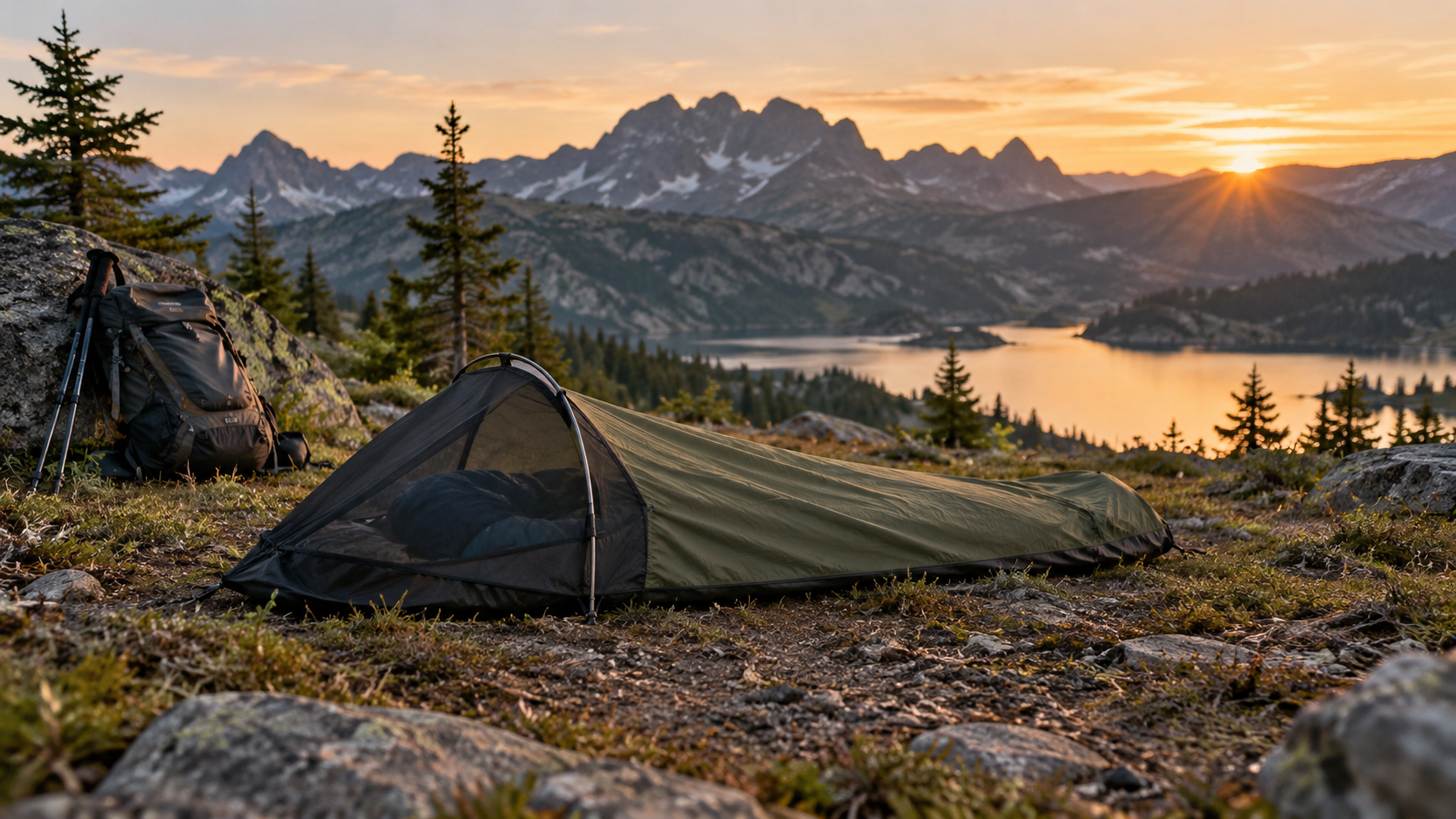
A bivy can mean very different things depending on the hiker carrying it.
For an ultralight backpacker, a bivy may be part of a deliberate shelter system used with a tarp. Another hiker may want a fully waterproof solo shelter that replaces a tent when traveling light. Mountaineers may value extra weather protection, while a day hiker may carry a compact bivy strictly as emergency backup.
Those products share the same basic name, but they do not do the same job.
For most hikers who want a genuine minimalist backpacking shelter, our best overall pick is the Outdoor Research Helium UL Bivy. The Katabatic Gear Piñon Bivy makes much more sense for an ultralight tarp-based setup, while the Outdoor Research Alpine XT Bivy and Big Agnes Three Wire Hooped Bivy provide more substantial shelter options. The SOL Escape Bivvy earns the fifth position because emergency protection is also a legitimate reason a hiker may be searching for a bivy.
This article contains affiliate links. If you purchase through these links, MoreHiking may earn a commission at no additional cost to you.
Quick Comparison: Best Hiking Bivy Sacks
| Bivy | Best For | Approx. Weight | What It Really Is |
|---|---|---|---|
| Outdoor Research Helium UL | Best Overall | 18.02 oz | Waterproof backpacking bivy |
| Katabatic Gear Piñon | Ultralight hikers | 7.5–8.7 oz | Breathable bivy for tarp/pyramid systems |
| Outdoor Research Alpine XT | Mountain weather | 20.95 oz | Waterproof mountain bivy |
| Big Agnes Three Wire Hooped | Four-season protection | About 19 oz | Structured pole-supported bivy |
| SOL Escape | Emergency backup | 8.5 oz | Breathable emergency bivy |
Before You Choose: What Kind of Bivy Do You Need?
If you are deliberately replacing a tent for minimalist backpacking, look first at a weather-resistant or waterproof bivy designed for regular overnight use.
If you already carry a tarp and want the lightest possible ground and bug protection around your sleep system, a lightweight bivy such as the Piñon serves a different purpose.
If your trips take you into exposed or unpredictable mountain conditions, additional weather protection and structure may justify some extra weight.
And if you simply want something compact in your pack for an unexpected night outside, an emergency-oriented bivy can be the correct choice—but it should not be confused with a normal backpacking shelter.
1. Outdoor Research Helium UL Bivy — Best Overall
The Outdoor Research Helium UL Bivy is our best overall choice because it sits in a useful middle ground between an extremely minimal tarp bivy and a conventional one-person tent.
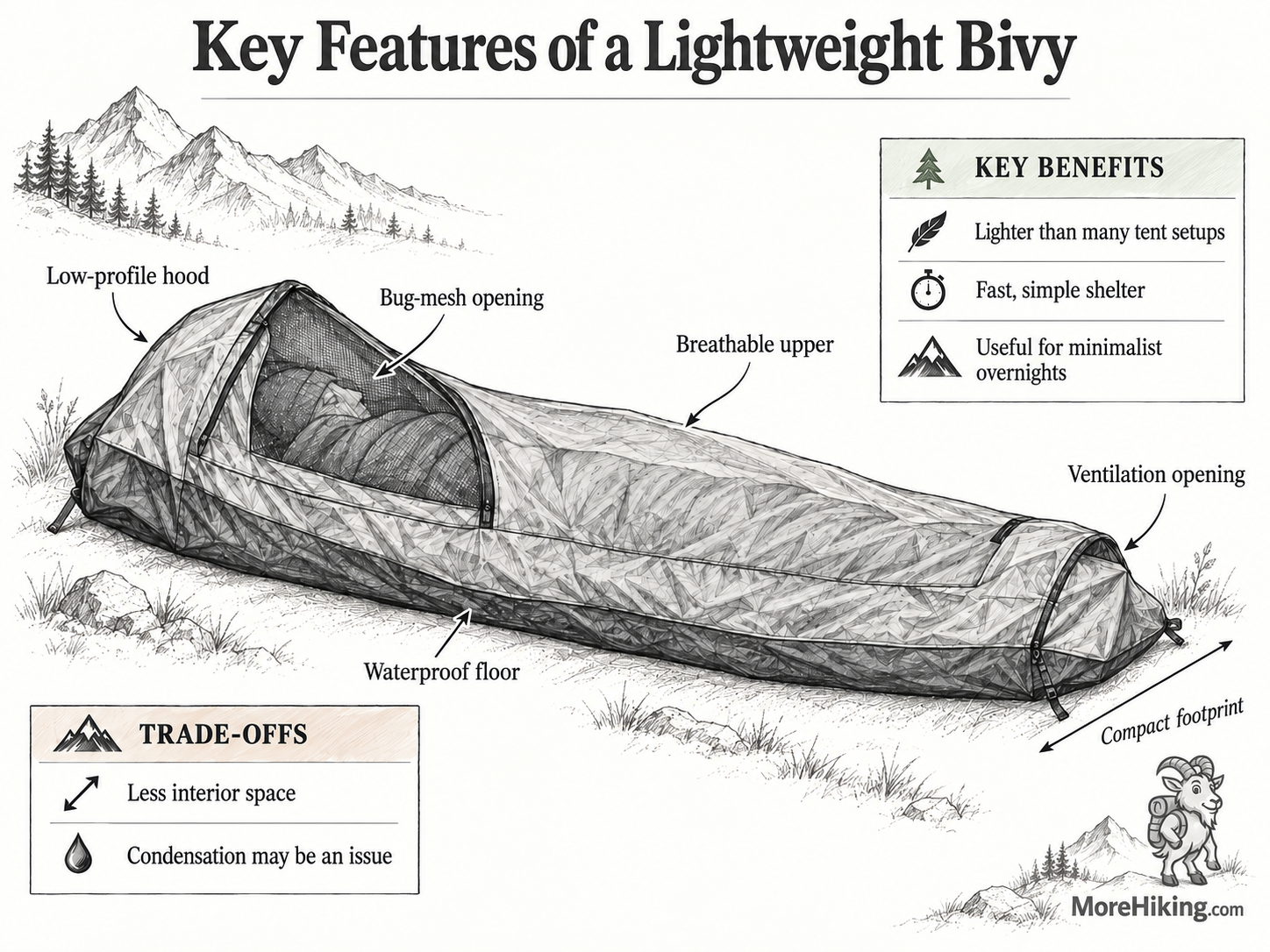
At about 18 ounces, it provides a waterproof Pertex Shield upper, waterproof floor and taped construction. A lightweight pole creates space around the head, while bug mesh and passive ventilation make it much more practical for planned overnight use than a simple sleeping-bag cover.
Why We Like It
It is light enough to appeal to hikers deliberately reducing shelter weight, yet it is much closer to a complete shelter than a simple ultralight cover.
It also demonstrates an important distinction: this is a shelter someone might intentionally use night after night, not merely something carried in case of emergency.
Main Limitation
A bivy still provides far less living space than a tent. Your sleeping area and shelter are essentially the same space, and moisture management remains important.
Best for: Backpackers, fastpackers and minimalist solo hikers who want a legitimate waterproof bivy rather than an emergency-only shelter.
Check Current Price and Availability at Amazon.Outdoor Research Helium UL Bivy
2. Katabatic Gear Piñon Bivy — Best for Ultralight Hikers
The Katabatic Gear Piñon Bivy represents another major branch of bivy camping.
Rather than trying to act like a tiny waterproof tent, the Piñon combines a waterproof floor with a highly breathable, water-resistant upper and is intended to work as part of a tarp or pyramid shelter system. Depending on size, it weighs roughly 7.5 to 8.7 ounces.
That changes how it should be evaluated.
Why We Like It
For an ultralight hiker already carrying a tarp, the Piñon adds ground protection, bug protection and another protective layer around the sleeping system without the weight of a conventional tent.
The generous mesh area is especially useful because airflow and moisture management matter enormously inside a small bivy.
Main Limitation
The Piñon should not be presented as a direct substitute for a fully waterproof standalone shelter in every condition. Its upper is designed to function as part of a broader shelter system.
Best for: Hikers deliberately building a lightweight tarp + bivy system.
For more on how that kind of shelter works, see MoreHiking’s flat tarp shelter system guide.
3. Outdoor Research Alpine XT Bivy — Best for Mountain Weather
The Outdoor Research Alpine XT Bivy moves farther toward weather protection.
The updated model weighs just under 21 ounces and uses a waterproof three-layer shell, waterproof floor and taped seams. It also incorporates mesh, passive ventilation and pole-supported headroom.
Why We Like It
The Alpine XT makes sense for the hiker whose bivy decision is being driven less by absolute minimum weight and more by the conditions in which the shelter may be used.
It still packs much smaller than a normal tent while providing considerably more weather-oriented construction than a simple ultralight bivy cover.
Main Limitation
That extra protection is unnecessary for many fair-weather backpackers. If most trips stay in mild three-season conditions, the lighter Helium UL or an appropriate tarp system may make more sense.
Best for: Solo mountain travel, exposed terrain and hikers who value weather protection more than shaving the final few ounces.
Check Current Price and Availability at Amazon.Outdoor Research Alpine XT Bivy
4. Big Agnes Three Wire Hooped Bivy — Best Four-Season Hooped Bivy
The Big Agnes Three Wire Hooped Bivy shows how close a modern bivy can move toward being a minimalist one-person shelter.
It is a pole-supported four-season design intended for fast-and-light solo use. A pole creates useful headroom, while the upper can be opened for entry and ventilation and closed down for increased weather protection.
Why We Like It
The extra structure makes it attractive to hikers who dislike having bivy fabric sitting immediately around their face.
It also occupies an interesting middle ground: significantly more shelter-like than an emergency bivy while remaining designed around minimalist solo travel.
Main Limitation
As a bivy becomes more structured and expensive, its advantages over an ultralight one-person tent become narrower.
Some hikers will decide that carrying a little more weight is worthwhile in exchange for dramatically more interior space.
Best for: Minimalist hikers who want a structured four-season bivy with additional headroom and protection.
5. SOL Escape Bivvy — Best Emergency Backup
The SOL Escape Bivvy is intentionally different from the other four recommendations.
It earns a place because emergency protection is a legitimate part of the hiking-bivy market, but it should be identified clearly rather than mixed indiscriminately with planned backpacking shelters.
The Escape weighs roughly 8.5 ounces and uses breathable, highly water-resistant reflective material. Unlike very thin disposable-style emergency bags, it is intended to be more durable and reusable.
Why We Like It
Its compact size makes sense for emergency shelter equipment, while its breathable construction gives it an important advantage over very basic reflective plastic emergency bags.
It may have limited lightweight-shelter applications in suitable conditions, but we would not present it as equivalent to a Helium, Alpine XT or Three Wire for planned bivy camping.
Main Limitation
It is an emergency-oriented shelter rather than a structured waterproof backpacking bivy.
There is no pole-supported living space, and its low weight should not be mistaken for evidence that it is simply a lighter version of the other products.
Best for: Hikers primarily looking for compact emergency backup rather than a regular overnight shelter.
If emergency shelter is your main concern, see MoreHiking’s guide to the best emergency shelters for hiking.
Check Current Price and Availability at Amazon.SOL Escape Bivvy
Backpacking Bivy vs. Emergency Bivy: Don’t Confuse the Two
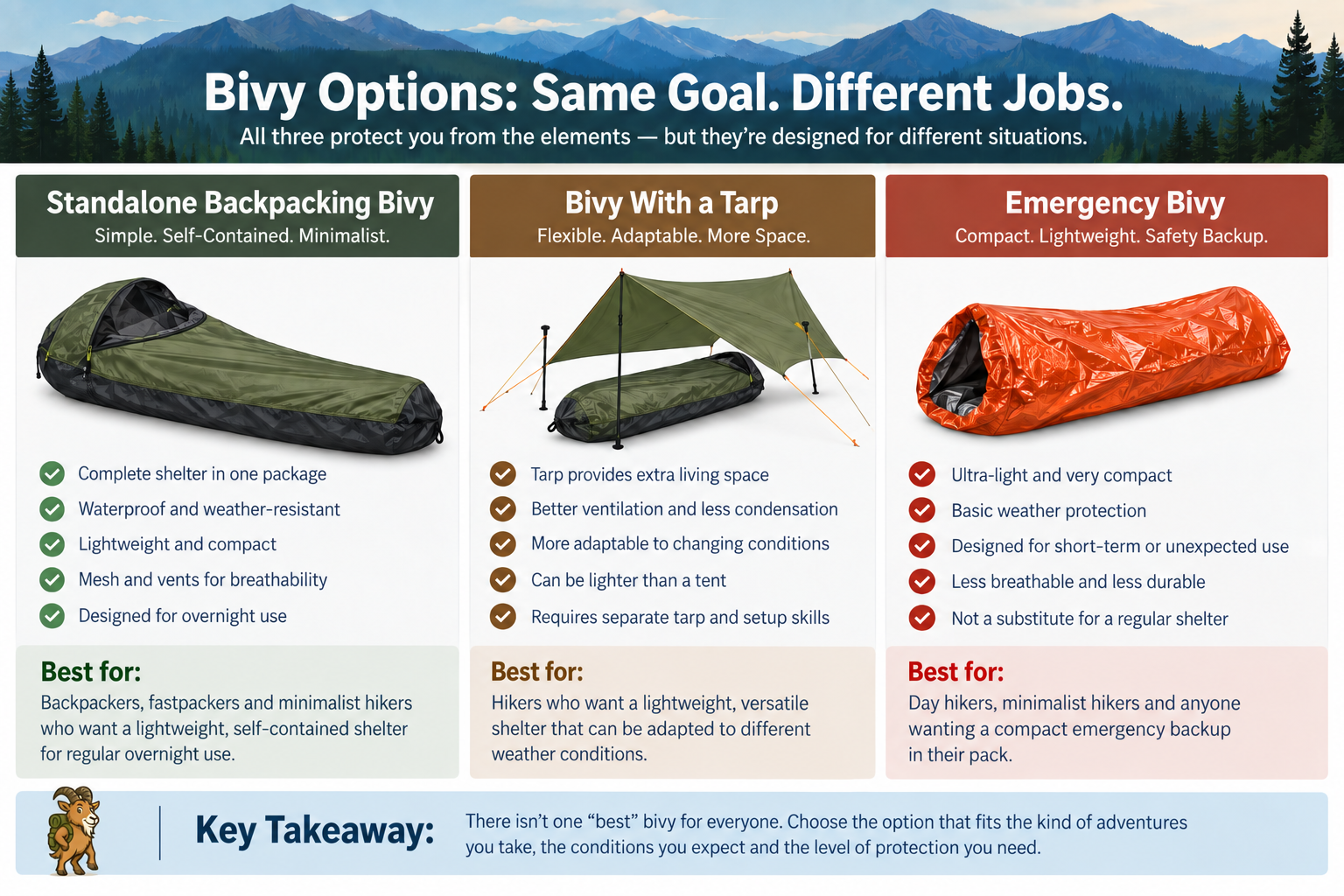
One of the easiest mistakes when shopping for a bivy is assuming every product carrying the word bivy is intended for the same job.
A backpacking bivy may be someone’s planned overnight shelter. It can include waterproof-breathable fabric, bug mesh, ventilation and even poles to create headroom.
An ultralight bivy may instead work as one component of a tarp-based shelter system, protecting a sleeping bag or quilt from ground moisture, insects and windblown spray.
An emergency bivy is normally carried because something may go wrong.
That distinction is why the lowest weight or lowest price should not automatically determine the best choice.
Bivy Sack or Tent?
A bivy becomes attractive when pack weight, small packed size, quick setup and a tiny campsite footprint matter more than interior living space.
A tent usually makes more sense when you want room to sit up, change clothes, organize gear, wait out extended bad weather or simply have some distance between your face and the shelter fabric.
If you are weighing those options, see MoreHiking’s guide to the best ultralight hiking tents.
What to Look for in a Hiking Bivy Sack
Shelter Role
First decide whether the bivy is the whole shelter, part of a tarp system, or primarily emergency equipment.
Everything else follows from that decision.
Weather Protection
Waterproof, water resistant and reflective emergency shelter are not interchangeable descriptions.
Match the construction to the conditions you realistically expect.
Ventilation and Condensation
Your breath and body moisture have very little space to escape inside a bivy.
Breathable fabrics, mesh panels and dedicated vents therefore matter almost as much as waterproofing.
Bug Protection
For warm-weather backpacking, good bug mesh can determine whether a bivy is practical at all.
Sleeping-Pad Compatibility
A sleeping pad remains an important part of the system. Check whether your preferred pad fits comfortably inside the bivy and whether the bivy provides adequate width around the rest of your sleep system.
MoreHiking’s guide to insulated sleeping pads can help you compare that part of the sleep system.
Weight vs. Livability
The lightest bivy is not automatically the best bivy.
A few additional ounces can buy meaningful weather protection, ventilation, easier entry and more space around your head.
Frequently Asked Questions About Hiking Bivy Sacks
What is the best hiking bivy sack?
For a hiker looking for a true minimalist backpacking shelter, our overall choice is the Outdoor Research Helium UL Bivy because it balances relatively low weight with waterproof protection, bug protection, ventilation and pole-supported headroom.
Are bivy sacks waterproof?
Some are, but not all. Waterproof backpacking bivies differ from ultralight bivies with water-resistant uppers, and both differ again from emergency bivies. Check the construction of the specific model rather than assuming bivy automatically means waterproof.
Can a bivy sack replace a tent?
Yes, for some hikers and trips. Backpackers who prioritize low weight, tiny packed size and fast setup may deliberately use a bivy instead of a tent. Others will find the restricted interior space too limiting.
Do bivy sacks have condensation problems?
They can. Because there is very little enclosed air volume, moisture from breathing and the sleep system can collect inside. Breathable fabrics, mesh and ventilation openings help, but site selection and proper ventilation still matter.
Do I need a tarp with a bivy?
It depends on the bivy. A waterproof standalone bivy may not require a tarp in normal conditions. Lightweight models such as the Katabatic Piñon are specifically intended to work effectively as part of a tarp or pyramid system.
Is an emergency bivy the same as a backpacking bivy?
No. Some emergency bivies are durable and breathable, but they are generally optimized for compact backup protection rather than the weather protection, ventilation, structure and livability expected from a planned backpacking shelter.
Which Hiking Bivy Sack Should You Choose?
There is no single bivy design that is best for every hiker because not every hiker is asking a bivy to perform the same job.
For most hikers deliberately choosing a bivy as their lightweight overnight shelter, the Outdoor Research Helium UL Bivy offers the best overall balance.
Choose the Katabatic Piñon if your shelter system is built around a tarp and minimum weight.
Move toward the Outdoor Research Alpine XT when protection in demanding mountain conditions matters more.
Consider the Big Agnes Three Wire Hooped Bivy if you want a more structured four-season bivy.
And choose the SOL Escape when the real purpose is compact emergency backup rather than routine bivy camping.
The key decision: do not choose a bivy simply because it weighs the least. Choose the one that fits the job you expect it to do once you are out on the trail.



Leave a Reply