

The sun is beginning to sink toward the horizon, and the woods are changing with it. Shadows stretch longer across the trail. The light loses its warmth. You reach a junction where the markers seem faded, the tread under your boots looks less defined, and the path ahead no longer feels quite right. You pull out your phone, but the screen is not giving you the certainty you hoped for. The blue dot drifts. The map hesitates. Your chest tightens.
Did I miss the turn back there? Am I even on the right trail anymore?
This is the moment when many hikers do not actually become lost. It is the moment when they begin to panic. That is an important difference.
A wrong turn is usually not the emergency. The emergency begins when a small mistake turns into rushed movement, second-guessing, and decisions made under stress. That process is what I call the wrong turn spiral. It happens when a hiker notices something feels off, ignores the warning, keeps moving, and gradually trades a manageable problem for a much larger one.
This article is about how to stop that spiral early. It explains how to recognize the first signs that you may be off route, what to do if you think you took a wrong turn while hiking, and how to use a simple navigation mindset to keep a small mistake from becoming a real backcountry problem.
This article contains affiliate links. If you purchase through these links, MoreHiking may earn a commission at no additional cost to you. We only recommend gear we trust and have carefully researched.
Why One Wrong Turn Isn’t the Disaster You Think It Is
Many hikers think about navigation in absolute terms. Either you are on the trail, or you are lost. Either everything is fine, or everything is going badly. In real life, it rarely works that way.
Most trail navigation mistakes begin small. A missed junction. A faint side path that looks more established than it really is. A trail marker that blends into bark or stone. A moment of distraction while talking, eating, checking a watch, or looking for a photo. The first error is often minor. What makes it serious is what happens next.
Once people begin to suspect they are off route, they often speed up instead of slowing down. They start trying to “fix” the problem while still moving. They tell themselves the trail will correct itself around the next bend. They assume the map is wrong, the markers are poor, or the trail is just rougher than expected. In other words, they start explaining away the evidence that something has changed.
That is where the spiral starts.
The moment you feel uncertainty, your body may react before your thinking does. You feel heat in your chest. Your breathing changes. Your thoughts narrow. Instead of calmly comparing what you know to what you see, you feel an urge to do something immediately. But on a trail, urgency without clarity is what pushes people farther away from their last known point.
That is why a wrong turn does not have to become a crisis. If you catch it early, it is often just a correction. If you ignore it and keep pressing forward, it can become confusion, exhaustion, and fear.
Understanding the “Wrong Turn Spiral” and How to Stop It Early
Disorientation usually does not arrive all at once. It tends to build through small signals that many hikers notice but dismiss. These are the yellow lights. They are not full emergency alarms yet, but they are warnings that your mental map may no longer match the ground beneath your feet.
Maybe the trail suddenly feels narrower, brushier, or less maintained than the last mile did. Maybe you have not seen a blaze, cairn, or marker in much longer than normal. Maybe the terrain no longer lines up with what you expected from your map, app, or trail description. Sometimes it is even more subtle than that. The woods simply stop feeling familiar.
That feeling matters.
A lot of hikers override that instinct because they do not want to admit they may have made a mistake. They keep going because turning back feels frustrating, or because they think stopping means overreacting. In reality, that first moment of doubt is often the moment when you have the most power to solve the problem cleanly.
These early warning signs are worth paying attention to:
| Early Cue of Disorientation | What Your Brain Tells You | What May Actually Be Happening |
|---|---|---|
| The trail becomes narrow or choked with brush | “It’s probably just a rough stretch.” | You may have drifted onto a game trail or unofficial path. |
| You have not seen a marker or blaze in a while | “I probably just missed one.” | You may have missed a junction or gone off the main route. |
| The terrain does not match your map or expectations | “The map must be off.” | You may not be where you think you are. |
| The trail feels unfamiliar in a vague but persistent way | “I’m probably just tired.” | Your situational awareness may be picking up a real mismatch. |
The important thing is not to panic when you notice one of these signs. The important thing is to interrupt the drift early. The sooner you acknowledge that something may be off, the easier it is to recover.
What the Wrong Turn Spiral Looks Like in Real Life
The wrong turn spiral is not just about being off trail. It is about how people behave once uncertainty enters the picture.
A hiker misses a turn, but instead of stopping, they keep going because the path still looks “close enough.” A few minutes later the trail becomes rougher, but they tell themselves that must be normal for this section. Then they realize they have not seen a marker for quite a while. At that point, turning back feels annoying, so they continue forward hoping for confirmation. Soon the route looks even less familiar. Now they are not just uncertain. They are emotionally invested in being right.
That is when poor decisions start stacking up.
They move faster. They stop checking the map carefully. They glance at the phone instead of really reading the terrain. They take a side path because it seems as though it should reconnect. They begin trying to recover the route by instinct rather than by evidence. With each step, the last known point gets farther away and harder to return to.
That is the spiral. The original mistake may have been small. The real danger comes from compounding it.

The Simple Navigation System Every Hiker Can Use
ou do not need to be an expert in cartography to avoid most wrong-turn situations. What helps most is having a repeatable way to stay oriented as you move. The goal is not to navigate perfectly. The goal is to always have enough awareness to notice when the trail and your expectations stop matching.
One simple approach is to build what you might think of as a breadcrumb system as you hike. Not literal breadcrumbs, of course, but a steady trail of observations that help the return route stay familiar in your mind.
Start With Orientation at the Trailhead
Before you leave the trailhead, take a moment to look around instead of rushing off. Notice the direction you are starting in. Identify any large terrain features that stand out, such as a ridge, a lake, a cliff line, or a prominent peak. If the trail initially climbs, descends, or contours, notice that too.
This first orientation matters because it gives you a baseline. If things start feeling uncertain later, you have a better chance of comparing your current surroundings to a known starting picture.
Pay Attention at Junctions
Most wrong turns happen where decisions happen. Junctions deserve a pause, even on easy trails.
When you reach one, stop and take a deliberate look at the path you are about to choose. Then turn around and look back the way you came. This matters more than many hikers realize. Trails often look very different in reverse, and the return view is the one you will need later.
This habit of reverse-looking is one of the simplest ways to reduce confusion on the way back out.
Use Handrails and Backstops
Natural features can help keep you oriented even when signage is poor. A handrail is a feature that guides your movement, such as a creek, a ridgeline, a fence line, or a shoreline. A backstop is something that tells you clearly when you have gone too far, such as a lake, road, canyon wall, or large trail intersection.
If you know the route stays above the river, the river is useful orientation information. If you know the lake marks the far end of your route, the lake is a backstop. These clues help you build a bigger picture than a single tread line in the dirt.
Build Mental Breadcrumbs as You Go
A reliable route is easier to follow when you are actively noticing it.
Look for memorable landmarks: a twisted pine, an odd-shaped boulder, a footbridge, a patch of ferns, a bend where the trail skirts a creek. These are the pieces that help you know whether the return path is matching what you remember. If you begin backtracking and those landmarks are missing, you know quickly that something is not lining up.
This is not about memorizing every detail. It is about moving through the trail with enough awareness that the route forms a sequence rather than a blur.
What to Do If You Realize You Are Lost While Hiking
If the trail ahead suddenly looks wrong, or if you find yourself staring at brush, faint tread, or terrain that does not make sense, this is the moment to stop trying to “push through” the uncertainty.
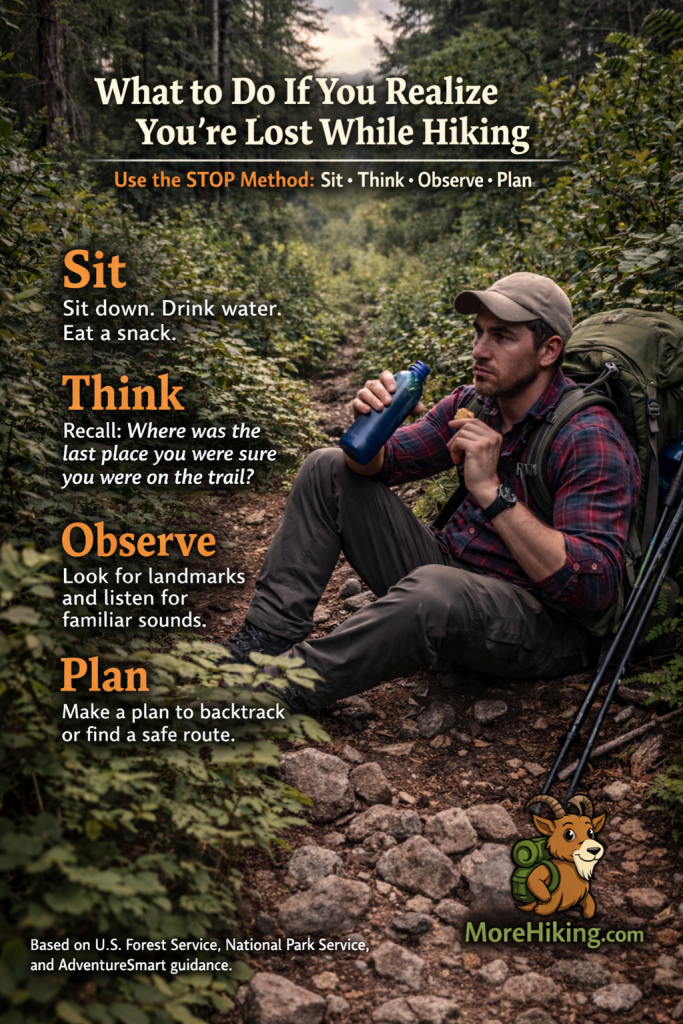
If you do find yourself staring at a wall of brush where the trail should be, use the STOP method.
Stop
Physically stop moving. Sit down if you need to. Take a drink of water. Eat a quick snack if that helps settle you. The goal is not comfort for its own sake. The goal is to interrupt the stress response that pushes you toward rushed, sloppy decisions.
You do not think more clearly by marching farther into uncertainty.
Think
Ask yourself one simple question: where was the last place I was completely certain I was on the right trail?
Do not look for a perfect answer. Look for the most recent reliable one. Maybe it was the signed junction ten minutes ago. Maybe it was the bridge crossing. Maybe it was the overlook where you checked the map. You are trying to reconnect to evidence, not guesswork.
Observe
Now look carefully at your surroundings. What terrain features do you see? What direction have you been traveling? Do you hear water, traffic, or other recognizable sounds? Does the route in front of you look like a maintained trail, or does it look more like a game path or drainage line? What does your map, compass, GPS, or watch say when you compare it calmly to the terrain rather than glancing at it in frustration?
This is the stage where you gather information instead of reacting emotionally to the absence of certainty.
Plan
Make one deliberate decision based on what you actually know.
In many cases, the best plan is to backtrack to your last known point. Follow your steps back. Look for the breadcrumbs you noticed earlier. Return to the junction, marker, or unmistakable trail feature where your confidence was still intact. From there, reassess.
What you should not do is try to “shortcut” your way toward where you think the trail should be. That is how hikers turn a correctable mistake into a larger emergency. Cutting across slope, descending blindly, or angling through brush because the route “must be over there somewhere” creates more variables at the exact moment when you need fewer.
At the same time, it is worth recognizing that backtracking is not automatically the right choice in every situation. If you are injured, losing daylight rapidly, dealing with severe weather, or completely unsure whether the terrain behind you is safer than where you are, staying put and sheltering in place may be the better decision. The central principle is not “always backtrack no matter what.” The principle is to stop compounding uncertainty and make the next move from a place of calm reasoning.
How to Prevent a Small Navigation Mistake From Becoming Serious
The best way to stop the wrong turn spiral is to develop habits that catch uncertainty early.
Pause at junctions instead of walking through them on autopilot. Compare the trail to your map before things feel wrong, not after. Turn around once in a while and study the return view. Notice changes in vegetation, terrain, and trail maintenance. Set a turnaround time before fatigue or fading light or night hiking flashlight starts shaping your decisions for you.
It also helps to avoid relying too heavily on any single tool. A phone can be useful, but it has real limits. Batteries drain. Screens become hard to read. Signals fail. GPS drift happens. Apps are helpful, but they work best when paired with the older habit of observing the world around you.
That does not mean every hiker needs advanced navigation training before taking a day hike. It means every hiker benefits from practicing basic orientation. You can do that in a neighborhood park, on a local conservation trail, or even on familiar walking routes. Notice landmarks. Predict return views. Check your direction of travel. Build the habit while the stakes are low.
Confidence on the trail does not come from believing you will never make a mistake. It comes from knowing that if you do make one, you have a system for catching it early and handling it well.
Building Confidence Before the Trail
The time to learn navigation habits is before you urgently need them.
Practice reading simple maps. Learn how a compass works, even if you do not plan to use one constantly. Understand why navigation belongs in the ten essentials. If you use electronic tools, back them up with a dependable GPS device or a hiking watch with trekking features rather than assuming your phone will solve everything for you.
Small practice sessions matter. On an easy walk, challenge yourself to remember the last three landmarks you passed. At a junction, guess what the return view will look like before you turn around. Follow a stream, ridgeline, or trail boundary and think about how it acts as a handrail. These are simple drills, but they train the exact awareness that helps prevent disorientation later.
The goal is not to become rigid or fearful. The goal is to move through the outdoors with enough awareness that a wrong turn stays what it usually is: a correction, not a crisis.
Final Thoughts
A wrong turn on the trail is usually not the emergency. Panic is.
The earlier you notice that something feels off, the more options you still have. If you stop, think clearly, observe your surroundings, and make your next move from evidence instead of stress, you can usually solve the problem while it is still small.
That is the real lesson behind the wrong turn spiral. The woods do not suddenly become dangerous because you made one imperfect decision. Trouble grows when uncertainty turns into rushed movement and avoidance. Catch it early, slow it down, and work from what you know.
That is how hikers turn a bad moment into a manageable one.
Please also read our other post.




Leave a Reply