
Introduction
The first time you consider leaving your tent behind, it rarely feels like a logical upgrade. It feels like a trade-off.
You’re giving up structure, walls, and something that has always felt like a clear boundary between you and the environment. In exchange, you gain a lighter pack and a simpler system—but also a sense of uncertainty that can be hard to ignore.
That hesitation is not a sign that minimalist shelter is unsafe. It’s a sign that you are stepping into something unfamiliar.
Many hikers are drawn toward tarps, bivies, or cowboy camping because of the efficiency they offer. But what keeps most people from committing to them is not a lack of gear—it’s a lack of confidence. Without that confidence, every shift in wind or change in temperature feels more significant than it actually is.
This article is not about convincing you to go lighter at all costs. It’s about helping you understand how experienced hikers make that transition without feeling exposed or reckless. Because in practice, minimalist shelter is not about carrying less—it’s about understanding more.
This article contains affiliate links. If you purchase through these links, MoreHiking may earn a commission at no additional cost to you. We only recommend gear we trust and have carefully researched.
What every hiker/backpacker should carry, but 90% forget.
What Is Minimalist Shelter? How It Works on the Trail
Minimalist shelter works by shifting where your protection comes from.
A traditional tent concentrates protection into a single piece of gear. It blocks wind, sheds rain, and creates a controlled space that feels consistent regardless of where you pitch it. Minimalist systems take a different approach. Instead of relying on one solution to solve every problem, they break those functions apart.
A tarp becomes your roof. A bivy adds a layer of protection from insects or moisture. A groundsheet manages contact with the terrain beneath you. None of these pieces are designed to do everything on their own, but together they form a system that adapts to conditions rather than resisting them.
This is why minimalist shelter can feel uncertain at first. The protection is still there—it’s just no longer automatic.
Once you begin to understand how these systems work, your attention shifts. You stop thinking about shelter as something you carry and start thinking about it as something you build using both your gear and your surroundings. This broader shift often happens alongside learning how to approach gear selection with a minimalist mindset, rather than relying on single-purpose solutions.
Why Minimalist Shelter Feels Risky (And Why It Usually Isn’t)
The feeling of risk that comes with minimalist shelter is real—but it’s often misunderstood.
What most hikers are reacting to is not increased danger, but reduced familiarity. A tent provides immediate reassurance because it behaves the same way in most environments. Minimalist systems, by contrast, respond directly to where and how they are used.
That difference creates a gap. Until you understand how to manage conditions, it can feel like something important is missing.
In reality, most three-season hiking conditions are far more forgiving than they are often imagined to be. Rain can be managed. Wind can be reduced through positioning. Cold is primarily handled by your sleep system, not your shelter.
The shift that experienced hikers make is subtle but important. They stop expecting their shelter to solve every problem and start making decisions that prevent those problems from developing in the first place.
That’s where confidence begins.
How Weather Awareness Supports Confidence (Without Overcomplicating It)
Weather is often the biggest source of concern when moving toward minimalist shelter. It’s also where many hikers overcomplicate things.
You don’t need to become an expert in forecasting to use a tarp or bivy effectively. What matters is developing a basic awareness of how conditions evolve and how they influence your setup.
Experienced hikers don’t rely on shelter to handle changing weather—they rely on timing and positioning. They notice when wind begins to shift, when clouds start to build, or when temperatures begin to drop, and they make small adjustments before those changes become uncomfortable.
If you want to explore this further, it helps to see how experienced backpackers read weather forecasts for shelter decisions, but the goal here isn’t to master forecasting—it’s to reduce uncertainty.
What matters is recognizing that awareness changes how you respond. When you begin to understand what’s coming, even at a basic level, your decisions feel more deliberate—and your shelter starts to feel like part of a system rather than your only line of defense.
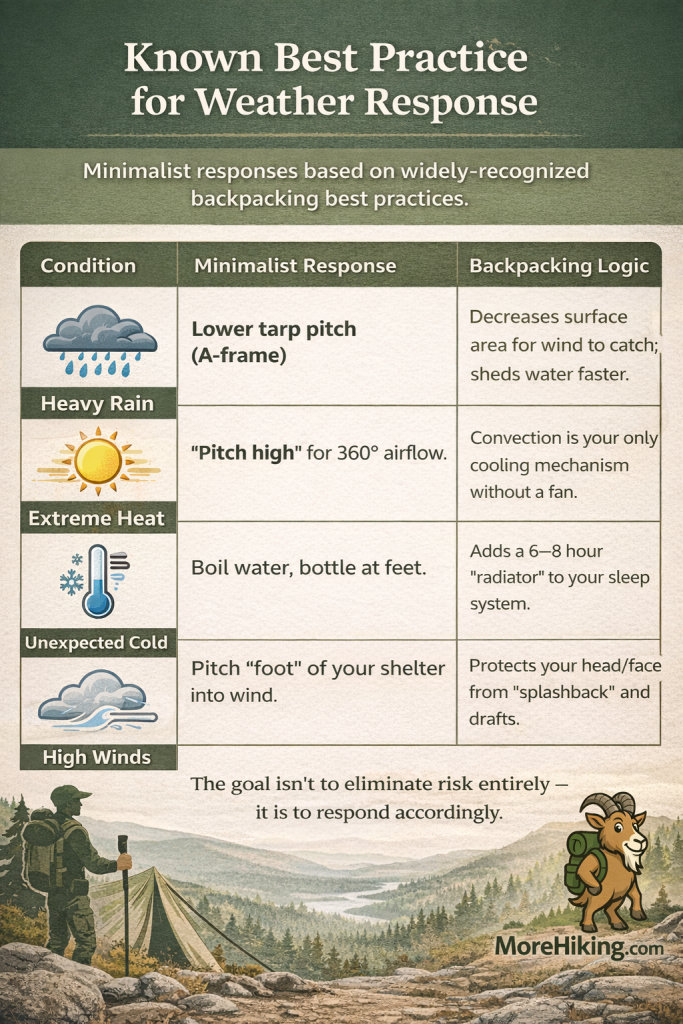
Most of the uncertainty around minimalist shelter comes from feeling like you need a complex solution for every condition. In practice, the adjustments experienced hikers make are often simple and repeatable.
They’re not carrying extra gear for every scenario—they’re making small changes to how they use what they already have.
The patterns below reflect how experienced backpackers typically respond to common conditions—not as rigid rules, but as examples of how awareness replaces the need for heavier shelter systems.
Choosing a Campsite That Does the Work for You
Campsite selection is where minimalist shelter begins to make the most sense.
A tent allows you to be somewhat casual about where you sleep. As long as the ground is flat, the structure handles most of the work. With minimalist shelter, the site itself becomes part of your protection.
A flat, open clearing may look ideal at first glance, but it often leaves you fully exposed to wind and shifting conditions. A slightly uneven area near a tree line may feel less convenient, but it changes how the environment behaves around you. Wind is softened, moisture drains more effectively, and the air feels more stable.
Small differences in terrain matter more than most hikers expect. Cold air settles in low areas, while wind accelerates through open ground. Even a slight elevation change can influence how comfortable a night feels.
Understanding these patterns turns campsite selection into an active decision rather than a passive one. It’s also where broader outdoor skills—like navigation skills for beginner hikers and terrain awareness—begin to play a much bigger role in how you use your shelter.
In wetter environments, ground conditions become just as important. Learning how to prevent water from seeping into your sleep system can often make the difference between a dry night and a miserable one.
Most hikers look for flat ground first and think about conditions second. Minimalist hikers tend to reverse that.
Instead of asking “Is this a good place to sleep?” they ask, “How will this spot behave overnight?”
That shift in thinking is what turns a campsite from something you find into something you choose.
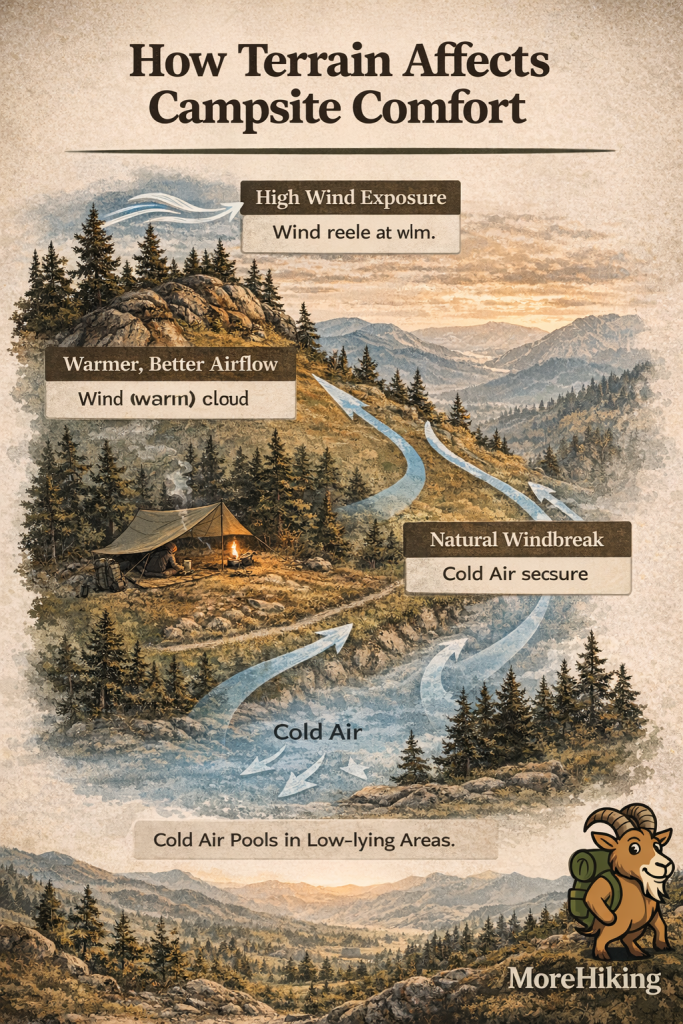
Once you start seeing terrain this way, your decisions become more deliberate. A small move up a slope, a few steps behind a windbreak, or avoiding a low pocket of cold air can have a greater impact than changing your shelter entirely.
Managing Bugs and Seasonal Conditions When Camping Light
Insects are a legitimate concern in certain environments, particularly in humid regions or during peak mosquito season. But they are also highly seasonal and often predictable.
Many hikers assume that going minimalist means accepting constant exposure to bugs, but that’s rarely the case. Lightweight bivies with bug netting, head nets, or simply choosing breezier locations can significantly reduce the issue.
In many regions, insect pressure drops dramatically later in the season. Shoulder-season trips often eliminate the problem almost entirely.
Understanding when insects are truly a factor—and when they’re not—allows you to adapt your shelter system rather than defaulting to heavier options year-round.
Minimalist Shelter Systems Explained (Without Overcomplicating the Choice)
There is no single “minimalist shelter setup.” Instead, there is a range of options that can be combined depending on your comfort level and the conditions you expect.
A simple tarp offers flexibility and excellent weight savings. A bivy adds protection from insects and helps manage moisture. Combining the two creates a system that balances simplicity with coverage.
Some hikers take this further by using multi-purpose gear like ponchos that double as shelter, reducing weight while maintaining flexibility in changing conditions, while others choose to cowboy camp entirely when conditions allow.
What matters is not choosing the lightest possible option, but choosing a system that matches your experience and the environment you’re moving through.
How to Transition Without Feeling Exposed
Confidence with minimalist shelter doesn’t come from a single decision—it builds over time.
Most hikers who make the transition successfully don’t start by abandoning their tent entirely. They begin in controlled conditions. Short trips. Predictable weather. Familiar terrain.
The first nights often feel different. Sounds carry more clearly. The environment feels closer. Small changes in wind or temperature seem more noticeable than they actually are.
But with each trip, something shifts.
You start recognizing better campsites. You adjust your setup earlier. You begin to anticipate how conditions will affect your comfort instead of reacting to them after the fact.
Mistakes are part of that process. A slightly exposed campsite, a tarp pitched too high, or ground that holds more moisture than expected—these moments are not failures. They are how experience builds.
And as that experience builds, the feeling of exposure is replaced by something more useful: control.
When Minimalist Shelter Isn’t the Right Choice
Minimalist shelter is not about removing protection in every situation. It’s about choosing the right level of protection for the conditions.
There are environments where a more structured shelter makes sense. Severe alpine weather, heavy snow, and highly unpredictable conditions can push beyond what minimalist systems are designed to handle comfortably.
Recognizing those limits is part of using minimalist shelter well.
Confidence doesn’t come from forcing a lighter setup into every situation. It comes from understanding when it works—and when it doesn’t.
Practical Use & Real-World Application
Using minimalist shelter effectively is less about technique and more about timing and awareness.
You begin noticing conditions earlier in the day. You think about where you’ll camp before you’re forced to choose. You set up while things are still calm rather than waiting until conditions become uncomfortable.
Over time, these decisions become second nature.
You stop asking whether your shelter is enough and start recognizing that your setup, your location, and your timing all work together. The system becomes less about the gear you carry and more about how you use it.
That’s when minimalist shelter stops feeling like a compromise and starts feeling like an advantage.
Minimalist Shelter FAQs: Confidence, Safety, and Transition
Is minimalist shelter really safe compared to a tent?
Minimalist shelter can be just as safe when used with good judgment. The difference is that safety comes less from the gear itself and more from how you use it—where you camp, how you set up, and how you respond to conditions.
Why does minimalist shelter feel uncomfortable at first?
It removes the familiar structure that tents provide. That initial discomfort comes from uncertainty, not increased risk. As you gain experience, that feeling shifts into awareness and control.
Do I need to replace all my gear to go minimalist?
Most hikers transition gradually. Replacing one piece at a time allows you to build experience without committing to a completely new system all at once. Check out our minimalist gear guide for specific recommendations.
What skills matter most when using minimalist shelter?
Campsite selection, terrain awareness, and understanding how conditions affect your setup are far more important than the shelter itself. To build these skills, revisit our guide on beginner navigation.
What’s the biggest mistake hikers make when going lighter?
Trying to remove too much, too quickly. Minimalism works best when it’s built on experience rather than forced decisions. Start with one lightweight change per trip to find your personal comfort limit.
When should I avoid minimalist shelter?
In severe or highly unpredictable conditions, such as high-altitude winter storms or sustained gale-force winds, a more protective, fully enclosed shelter is often the better choice. Good judgment is a fundamental part of the system.
Final Thoughts
Over time, what once felt like exposure begins to feel intentional.
You start to notice the landscape differently—the way wind moves through terrain, how small changes in elevation affect temperature, how your setup interacts with the environment rather than resisting it.
Your shelter becomes less about creating a barrier and more about working with what’s already there.
And with that shift, confidence replaces hesitation—not because you’re carrying more, but because you understand more.
The goal isn’t to carry less for the sake of it—the goal is to carry exactly what the conditions require, and nothing more.
If you have enjoyed this article, please also read our other post.
Leave a Reply