
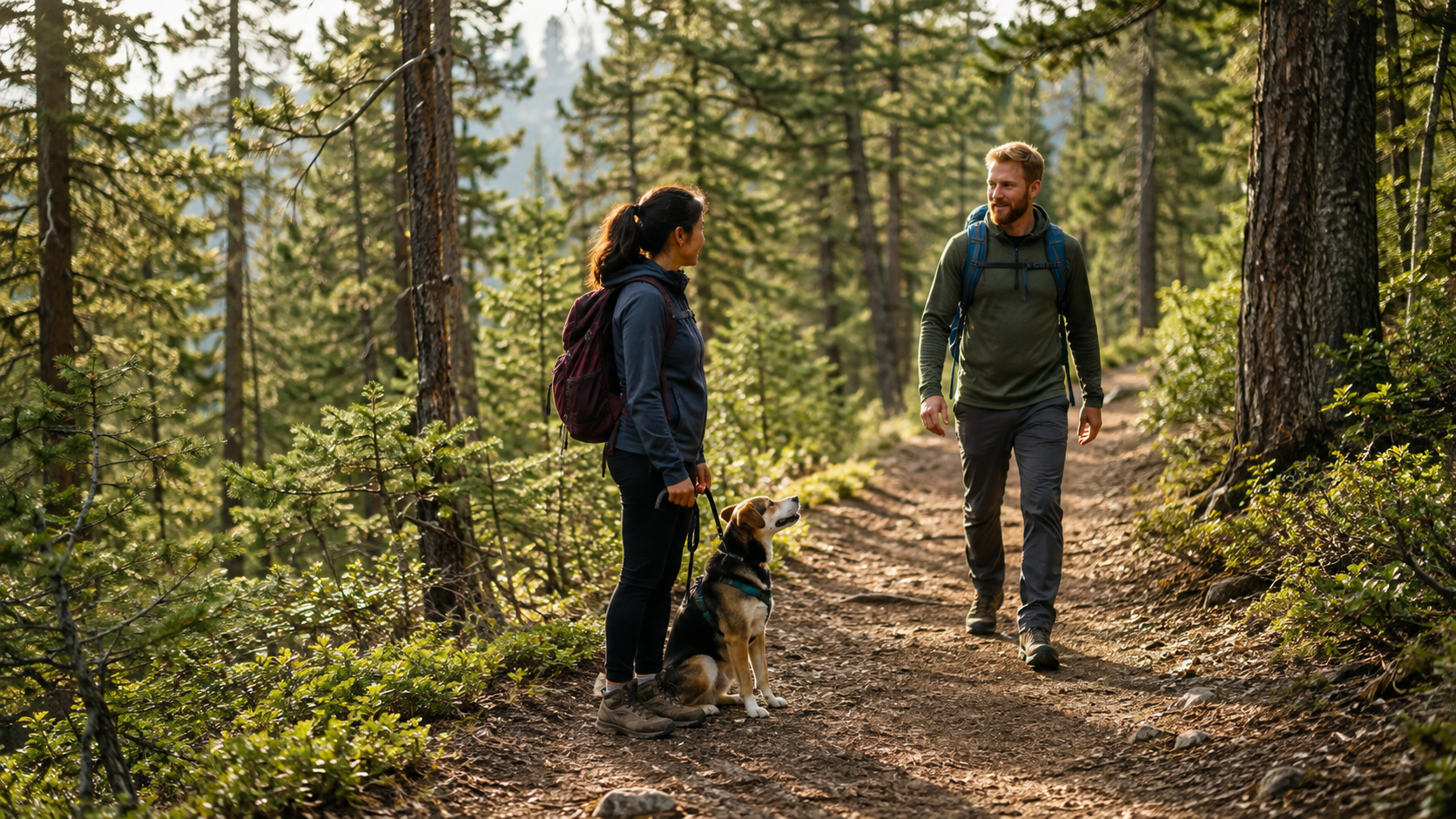
Dog trail etiquette is not complicated, but it does require you to think about more than whether your dog is friendly.
A shared trail includes people who love dogs, people who are afraid of them, dogs that are social, dogs that need space, horses that can spook, cyclists moving faster than you expect, and wildlife that should never have to adjust to a domestic dog. Your job is to manage your dog so other trail users do not have to manage the encounter for you.
The simplest rule is:
Know the local requirement, keep your dog under effective control, and create space before an encounter becomes difficult.
That often means using a leash even when your dog has excellent recall. It means not allowing surprise greetings. It means treating wildlife as a reason to increase control, not as a test of obedience. And it means carrying your dog’s waste until you can dispose of it properly.
Good dog trail etiquette is less about proving how well trained your dog is and more about making the trail easier for everyone sharing it.
Trail Etiquette Starts Before You Leave the Trailhead
Before you think about passing etiquette, recall, or other dogs, check whether your dog is actually allowed where you plan to hike.
Rules differ by land manager and sometimes by trail within the same park. Some areas allow leashed dogs on many trails. Others restrict dogs to specific routes or developed areas. Seasonal wildlife closures can also change access.
For U.S. hikers, the exact rule depends on the land manager and the specific site. National Park Service guidance tells visitors to check the park they plan to visit because pet access differs by park and trail. Check the applicable agency page and posted trail rules before you leave.
That makes trail access your first etiquette decision.
If a trail requires a leash, strong recall does not create an exception. If dogs are prohibited, a quiet or well-trained dog does not create an exception. Responsible dog hiking begins by accepting the rules of the place you chose to visit.
If you are still deciding where to hike, start with our guide to choosing a dog-friendly backpacking route, including rules, terrain, water, weather, and exit options.
Use the Amount of Leash Freedom the Situation Earns
A leash is not only a legal requirement in many places. It is also a way to make your dog predictable to everyone else.
On a quiet, wide trail where local rules allow it, you may be able to give your dog more working room. On a narrow trail, near a blind corner, around children, around another dog, near a horse, or anywhere wildlife is active, shorten the distance.
The goal is not to keep your dog glued to your knee all day. The goal is to avoid giving your dog more room than you can safely manage.
A long leash stretched across the trail can become a trip line. A dog far ahead may reach another hiker before you do. A dog behind you can disappear around a bend while you are still looking forward.
As traffic or uncertainty increases, bring your dog closer.
A secure harness and leash system can make that easier, but equipment only supports the behavior. It does not replace attention.
Passing Hikers: Make the Encounter Boring
Most passing encounters should feel uneventful.
If another hiker approaches, shorten the leash before the person reaches you and keep your dog on the side you can control most easily. On a narrow trail, look for a safe place to pause without trampling vegetation or blocking the tread.
Normal trail right-of-way still matters. National Park Service hiking-etiquette guidance generally gives uphill hikers the right-of-way, while local signs may establish different rules. Having a dog does not automatically rewrite those conventions.
Dog handlers can still choose extra courtesy. If the easiest, safest option is to pause with your dog close while another person passes, do that. The objective is not to win a right-of-way argument. It is to prevent your dog from crowding, sniffing, jumping toward, or startling someone who did not choose the interaction.
Friendly is not the same as invited. A person does not need a reason to decline contact with your dog.
Passing Another Dog: Do Not Assume They Should Meet
Two dogs approaching on leashes do not need to greet.
One of the easiest ways to keep a trail calm is to avoid turning every dog encounter into a social event.
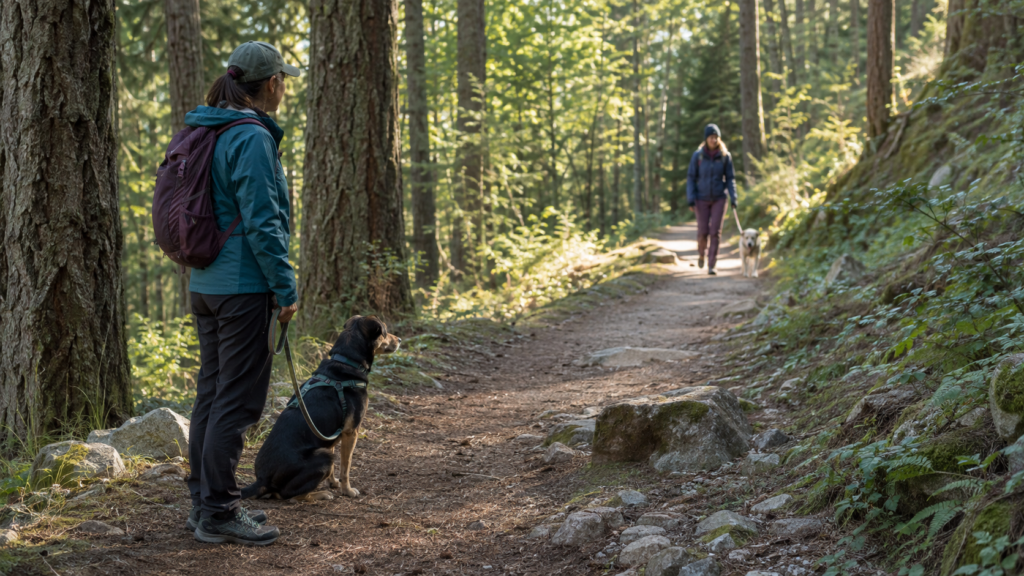
Shorten your leash early and watch the other handler. If they step aside, increase distance, hold their dog close, or clearly avoid contact, respect the message immediately.
Do not let your dog pull across the trail to “say hello.” Do not continue approaching simply because your dog is friendly. The other dog may need space for behavior, health, age, training, or reasons you cannot see.
If both handlers clearly want a greeting and the location is appropriate, keep it brief and controlled. Greetings should be optional, not expected.
On a narrow trail, you may need to stop at a wider point or back up several steps to create room. That is usually easier than forcing two dogs past each other at leash length.
Horses and Bikes: Make Space Early and Stay Predictable
Shared-use trails require a little more planning when your dog is with you.
Hikers generally yield to horses and other pack stock. If a horse is approaching, bring your dog under close physical control early. Pause and communicate with the rider. Follow local trail rules and any reasonable direction the rider gives for a safe pass.
Avoid sudden movement or allowing your dog to rush toward the animal. Horses can be startled, and the safest passing position can depend on the trail and the rider.
On many shared trails, cyclists yield to hikers, but local rules and signs control. Either way, do not leave a leash stretched across the tread while a cyclist approaches. Bring your dog close and create a predictable lane for the pass when it is safe.
If you hear a bike approaching from behind, get the dog close before the cyclist reaches you.
Good etiquette is not only about who technically has priority. It is about reducing surprises.
Recall Is a Backup Skill, Not Permission
A strong recall is valuable.
It can help if a leash slips, if your dog starts toward something unexpected, or in an area where off-leash use is explicitly permitted.
But recall does not override a leash rule.
Even a well-trained dog can react differently to wildlife, an unfamiliar dog, a horse, food, fast movement, or a new environment. Where off-leash use is legal, your dog still needs to remain under effective control and should not approach people, dogs, horses, or wildlife without invitation.
If you cannot reliably prevent those approaches, the leash is the better tool.
Recall should add a layer of safety. It should not be used to remove one.
Reactive Dogs: Create Distance Before You Need It
Some dogs need more space around dogs, people, bikes, or other triggers. Trail etiquette for those dogs begins with management.
Management guidance for fearful dogs published by the American Veterinary Society of Animal Behavior describes practical strategies such as choosing quieter times and places, keeping distance from triggers, using the environment as a visual barrier, and communicating that your dog needs space.
Those principles fit trail encounters well.
Do not wait until your dog is lunging or barking to solve the situation. When you see a trigger ahead, look for room to pause, turn around briefly, use a safe visual barrier, or tell the approaching handler that your dog needs space.
Sometimes the courteous choice is to leave a section of trail rather than force your dog through an encounter they cannot handle calmly.
This is trail-management guidance, not a behavior-treatment plan. If your dog’s reactions are difficult to control or create a safety concern, seek help from an appropriately qualified veterinary or behavior professional.
Wildlife Changes the Decision Immediately
Wildlife is not another trail user to pass. It changes the situation.
National Park Service guidance emphasizes keeping pets under control and away from wildlife. An uncontrolled approach can disturb wildlife and can also put the dog and handler at risk.
When you see wildlife, shorten the leash and increase distance.
Do not let your dog chase a small animal, rush toward a deer, or approach wildlife as a test of obedience. If wildlife is occupying the trail, you may need to stop, back away, wait, or turn around depending on the species and the land manager’s guidance.
Species-specific wildlife safety belongs in species-specific guidance. The correct response to a bear is not necessarily the correct response to a moose, bison, snake, or coyote.
The etiquette principle is simpler:
Your dog should not be allowed to chase, harass, or approach wildlife.
Dog Waste: Remove It From the Trail System
Dog waste is your responsibility from the moment it hits the ground.
The National Park Service’s B.A.R.K. guidance tells visitors to bag pet waste and clean up after their pets.
For most hikers, the safest default is straightforward:
Bag it and carry it until you reach an appropriate disposal point.
Do not leave a filled bag beside the trail because you intend to collect it on the way back. Plans change, bags get forgotten, and meanwhile the waste is still sitting on the trail.
If a specific land manager gives another approved disposal method, follow that local instruction. The rule of the place takes priority over a general habit.
A dedicated waste pouch or odor-control container can make carrying used bags easier on longer hikes.
Quick Trail-Encounter Guide
| Situation | Best first move | What to avoid |
|---|---|---|
| Hiker approaching | Shorten the leash and give a clean passing lane | Letting the dog approach without invitation |
| Another dog approaching | Create space and watch the other handler | Assuming the dogs should greet |
| Horse approaching | Bring the dog close, pause, communicate, and follow local yield rules | Sudden movement or letting the dog rush the horse |
| Bike approaching | Move the dog close and keep the trail predictable | A leash stretched across the tread |
| Reactive-dog trigger ahead | Increase distance early | Waiting for barking or lunging before acting |
| Wildlife spotted | Shorten the leash, increase distance, and follow local guidance | Chasing, approaching, or testing recall |
| Dog defecates | Bag it and carry or dispose of it according to local rules | Leaving the bag beside the trail |
The Trail-Ready Etiquette Test
Before hiking with your dog, you should be able to answer five questions:
- Do I know whether dogs are allowed on this trail?
- Do I know the leash requirement?
- Can I bring my dog close and under control before another trail user reaches us?
- Can I create distance instead of forcing a greeting?
- Can I carry my dog’s waste for the rest of the hike if I have to?
If the answer to any of those is no, solve that problem before relying on the trail to solve it for you.
Good dog trail etiquette is a system that makes your dog predictable, gives other people choices, and protects the place you came to enjoy.
Conclusion: Be the Team Other Trail Users Can Trust
The best dog-and-hiker teams are not necessarily the ones with the fastest pace or the most advanced training.
They are the ones other trail users do not have to worry about.
They know the local rules. They shorten the leash before an encounter. They do not force greetings. They give horses and wildlife room. They manage distance before a reactive situation escalates. They pick up waste. And they change the plan when the trail becomes a poor fit for the dog.
That responsibility helps keep shared trails safer and calmer for everyone, including people who want to continue enjoying them with dogs.
For the larger system behind preparing and managing a dog on overnight trips, continue with The Trail-Ready Team guide to backpacking with dogs.
Frequently Asked Questions
Can my dog hike off leash if their recall is excellent?
Only where off-leash use is explicitly allowed. Strong recall does not override a leash rule or dog restriction. Even in legal off-leash areas, your dog should remain under effective control and should not approach people, dogs, horses, or wildlife without permission.
What should I do when another dog is approaching on a narrow trail?
Shorten your leash and look for a wider place to pause or pass. Do not assume the dogs should greet. If the other handler is creating distance, help them by giving more room.
Do hikers with dogs always have to yield?
Not automatically. Follow posted right-of-way rules. On many trails, uphill hikers have priority and hikers yield to horses. Dog handlers can still choose extra courtesy when pausing with the dog makes an encounter safer and easier.
What should I do with a bag of dog waste if there is no trash can?
Carry it until you reach an approved disposal point, unless the land manager explicitly gives another method. Do not leave filled bags beside the trail for later collection.
Leave a Reply