
Introduction
If you spend enough nights outside, you eventually learn that shelter decisions are rarely about comfort alone. They’re about risk management.
Backpackers who rely on tents can often default to a predictable system: pitch, zip, and ride out the night. But hikers who move toward minimalist systems—cowboy camping, tarp setups, bivy systems, or stealth camping—don’t have that same buffer.
When your shelter might be nothing more than a tarp or the open sky, weather stops being background information and becomes something you actively interpret long before you stop walking. This is especially true when you’re learning how to read a weather forecast for hiking, where small details can determine whether a minimalist shelter setup works—or fails overnight.
Experienced backpackers don’t just check if it might rain. They read forecasts as patterns. Many experienced hikers rely on detailed hourly forecasts, such as those provided by NOAA, because they show how conditions change throughout the night rather than summarizing them into a single percentage. They look at timing, wind, temperature spread, humidity, and terrain interaction to answer a more important question:
“What will this actually feel like where I’m sleeping?”
That’s the difference between a calm, dry night under the stars—and waking up at 2 a.m. scrambling to protect your gear.
This guide will show you how experienced hikers make those decisions.
This article contains affiliate links. If you purchase through these links, MoreHiking may earn a commission at no additional cost to you. We only recommend gear we trust and have carefully researched.

What every hiker/backpacker should carry, but 90% forget.
How to Read a Weather Forecast for Backpacking Shelter Decisions
The prediction isn’t going to be exact—it’s recognizing when conditions are stable enough to stay exposed, and when they’re not.
Most beginners read weather forecasts like a headline: sunny, cloudy, or a percentage of rain. But experienced backpackers know that these summaries hide the details that matter most.
A forecast is not a guarantee—it’s a probability across a broad area.
When you see a “30% chance of rain,” that doesn’t mean light drizzle is likely. It means that within the forecast zone, there is a 30% chance that measurable precipitation will occur somewhere.
That could mean nothing at your campsite.
Or it could mean a storm passes directly over you.
The difference comes down to understanding the underlying pattern.
Experienced hikers look deeper. They examine how different elements interact:
- Timing of precipitation relative to sleep hours
- Temperature compared to dew point
- Wind speed and directional changes
- Humidity trends
- Cloud development and sky conditions
These variables don’t exist in isolation. Together, they tell a story about atmospheric stability.
A calm, dry, stable system behaves very differently from a humid, shifting, unstable one—even if both show similar rain percentages.
Learning to read that story is what allows backpackers to confidently choose lighter shelter systems.
What Stable vs. Unstable Weather Actually Looks Like on Trail
Experienced backpackers don’t rely on a single forecast detail—they read the overall pattern developing overnight.
Our goal is for an exact prediction—it’s recognizing when conditions are stable enough to stay exposed, and when they’re not.
This is where experience begins to replace guesswork.
A stable weather pattern often feels predictable. On these nights where everything feels stable—dry air, calm wind, clear skies—these are typically ideal cowboy camping weather conditions.
An unstable pattern, on the other hand, often announces itself subtly. The air feels heavier. Clouds build or thicken late in the day. Winds shift direction rather than holding steady. Temperatures don’t drop as expected.
Even if rain isn’t guaranteed, instability introduces uncertainty.
And uncertainty is what minimalist shelter systems struggle with most.
Experienced backpackers aren’t just asking, “Will it rain?”
They’re asking:
“Is the weather stable enough that nothing unexpected is likely to happen overnight?”
Quick Summary: How Backpackers Choose Shelter Based on Weather
- Stable, dry air with calm wind usually supports cowboy camping
- Rising humidity or temperatures near the dew point often lead to condensation
- Increasing or shifting wind suggests changing conditions and possible instability
- Uncertain or mixed signals often justify a simple tarp setup over full exposure
The 5-Minute Forecast Check Experienced Backpackers Use
Before committing to a shelter setup, experienced hikers often run a quick mental checklist. It’s not complicated—but it’s deliberate.
First, they look at timing, not just probability. If precipitation is expected after sunrise, that’s very different from storms arriving at midnight.
Next, they compare overnight temperature to dew point. If those numbers are close, condensation is almost guaranteed—even without rain.
Then they check wind trends, not just current speed. A calm evening with increasing overnight wind can signal an approaching front.
After that, they look for instability signals—rising humidity, shifting wind direction, or increasing cloud cover.
Finally, they match those conditions to a shelter choice:
- Stable, dry, calm → cowboy camping
- Moderate uncertainty → tarp
- High variability or storms → full shelter
This process takes less than five minutes, but it prevents most uncomfortable nights.
Don’t just hike—be prepared. Shop Camping Survival.
Key Considerations & Decision Factors
Precipitation Timing Matters More Than Percentage
A 40% chance of rain overnight means very little on its own. What matters is when that rain is likely to arrive.
This is where choosing shelter based on weather becomes less about reacting and more about understanding what the conditions are building toward.
If precipitation is expected in the early morning hours, many experienced hikers will still cowboy camp, knowing they can pack quickly at first light. But if storms are expected during the night, especially during deep sleep hours, a tarp or tent becomes a safer choice.
The risk isn’t just rain—it’s your ability to respond to it.
Dew Point Predicts a “Dry Night” Better Than Rain Forecasts
Condensation is one of the most misunderstood factors in backcountry camping.
If the overnight low temperature approaches the dew point, moisture will condense onto surfaces—including your sleeping bag or quilt.
This is why some hikers wake up soaked even when no rain falls.
When the temperature and dew point are within a couple of degrees, experienced hikers expect moisture. In those conditions, they often use a bivy, pitch a tarp, or seek tree cover to reduce exposure.
A large gap between temperature and dew point usually signals a dry night.
Wind Is a Shelter Decision, Not Just a Comfort Factor
Wind changes everything.
Even moderate winds can strip warmth, disrupt sleep, and destabilize tarp setups. More importantly, shifting winds often signal changing weather conditions.
A forecast showing increasing wind overnight—especially with directional changes—should raise caution.
Experienced hikers respond by choosing sheltered campsites, orienting tarps carefully, or opting for more secure shelter systems.
Cloud Cover Changes Temperature Behavior
Clear skies allow heat to escape rapidly after sunset, leading to colder-than-expected nights. This is known as radiational cooling.
Cloud cover can actually insulate the landscape, trapping heat and stabilizing temperatures.
This matters when choosing sleep systems and shelter exposure. A clear, calm forecast may feel ideal for cowboy camping—but it may also be colder than expected.
Terrain Can Override the Forecast
Weather forecasts apply to broad areas, but your campsite exists in a specific microclimate.
Cold air settles into valleys. Wind accelerates over ridges. Moisture lingers near water sources. Tree cover can reduce both wind and dew formation.
Experienced backpackers mentally adjust forecasts based on where they plan to sleep.
A “light wind” forecast may feel calm in a forest—but harsh on an exposed ridge.
Shelter Choices Based on Forecast Interpretation
When backpackers interpret weather forecasts effectively, they gain flexibility in how they sleep outdoors. Instead of defaulting to a tent every night, they can choose the shelter that best fits the conditions.
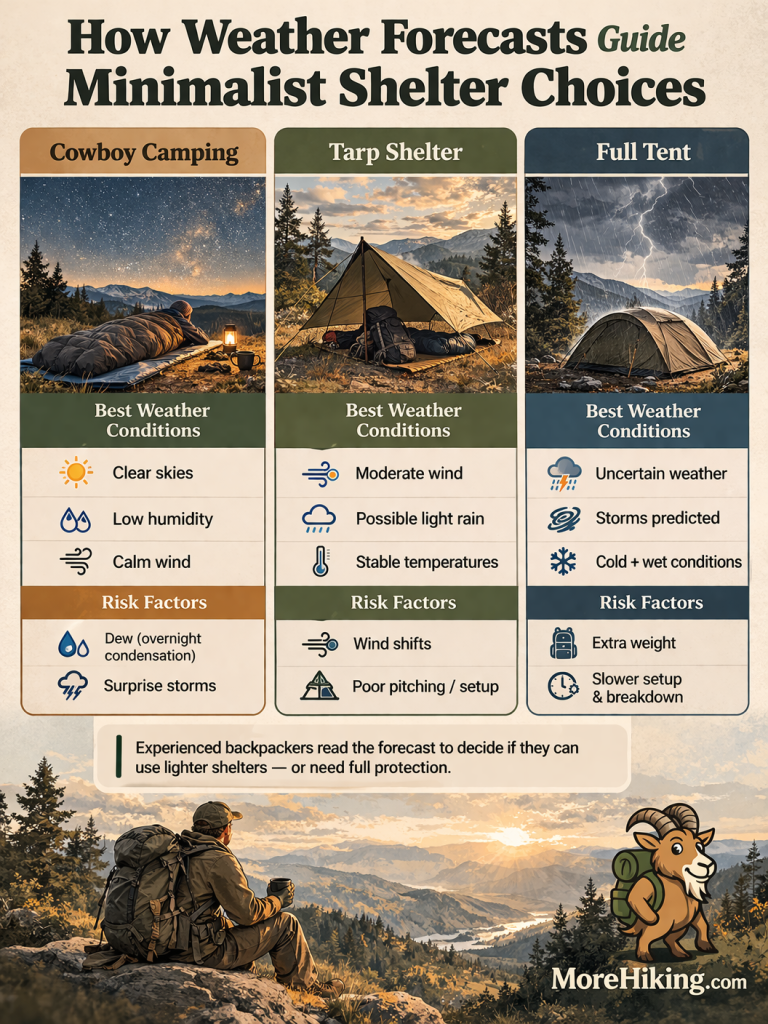
In many cases, hikers begin to understand when a tarp is enough simply by recognizing how stable or unstable the overnight pattern feels.
How Experienced Backpackers Make the Call (Real-World Example)
It’s late afternoon. You stop for water and check your forecast.
The temperature is expected to drop to 9°C overnight. The dew point is 8°C. Wind is calm now but forecast to increase slightly after midnight. Rain probability sits at 20%.
At first glance, it looks like a good night to cowboy camp.
But look closer.
The temperature and dew point are nearly identical—condensation is very likely. The slight increase in wind suggests a weak system moving in. Even though rain probability is low, the pattern isn’t fully stable.
An experienced backpacker reads this differently.
Instead of cowboy camping, they choose a simple tarp setup. Not because conditions are severe—but because they’re uncertain.
That small adjustment often makes the difference between a comfortable night and damp insulation by morning.
A Common Mistake: When the Forecast Looks Fine (But Isn’t)
Most experienced hikers have a story like this.
The forecast shows a low chance of rain. The evening is warm and calm. The sky is partly clear. Everything feels safe for cowboy camping.
Sometime after midnight, clouds roll in. The air becomes heavy. A light drizzle begins—not enough to justify the forecast’s rain percentage, but enough to soak exposed gear.
These are the kinds of situations where having a basic plan for unexpected conditions becomes important, especially if you’re forced to adjust in the dark.
The mistake wasn’t ignoring the forecast.
It was failing to recognize the pattern of instability—rising humidity, cloud buildup, and subtle shifts in the air.
These experiences teach backpackers to trust patterns over percentages.
Why the Forecast Is Often “Wrong” Where You Sleep
Forecasts are built for regions—not specific campsites.
This is why conditions can feel dramatically different from what you expected.
A valley campsite may be colder and wetter than forecast. A ridge may be windier. A site near water may have higher humidity and heavier dew.
Experienced hikers don’t see forecasts as wrong—they see them as incomplete.
They combine forecast data with terrain awareness to build a more accurate picture of what the night will actually bring.
Practical Use on Trail
Most backpackers don’t make shelter decisions once—they refine them throughout the day.
They check forecasts during breaks. They watch the sky. They feel changes in the air.
High clouds moving in late in the day, shifting wind direction, or a warm, humid evening can all signal changing conditions.
By the time they reach camp, experienced hikers aren’t guessing. They’re confirming.
And when there’s uncertainty, they lean toward flexibility—choosing setups that allow quick adjustment if conditions change overnight.
That mindset is what keeps minimalist systems effective rather than risky.
Final Thought
Experienced backpackers don’t try to eliminate risk entirely.
They learn to recognize it early, understand it clearly, and respond accordingly.
Because in the backcountry, the goal isn’t perfect prediction— it’s making the right decision with imperfect information.
Frequently Asked Questions: Weather & Dew Point
What dew point is too high for cowboy camping?
When the overnight low temperature is within 1–2°C (or about 2–4°F) of the dew point, condensation becomes very likely. In these conditions, cowboy camping often leads to damp gear by morning unless you have some form of protection, such as a bivy or a high-pitched tarp to allow airflow.
How accurate are hourly forecasts in the mountains?
Hourly forecasts are useful, but terrain can alter conditions significantly. Mountains create microclimates where timing and intensity of weather events may shift rapidly. Experienced hikers use digital forecasts as a general guide, then adjust their plans based on real-time observation of cloud movement and pressure changes.
What wind speed makes tarp camping difficult?
Sustained winds above 20–30 km/h (12–18 mph), especially when accompanied by unpredictable gusts or shifting directions, can make tarp setups unstable. In these conditions, site selection behind natural windbreaks and choosing low-profile pitches like the “half-pyramid” become critical for safety.
Can you predict condensation without checking dew point?
You can often estimate risk by feel—high humidity, lingering warmth after sunset, and a total lack of airflow often signal a high condensation risk. However, checking the dew point remains the most reliable and precise indicator for preventing a soaked sleeping bag.
Is it ever safe to ignore a low rain percentage?
Sometimes—but only if the broader weather pattern is exceptionally stable. A low rain probability (like 10-20%) combined with rising humidity, shifting winds, or building cumulus clouds should still be treated with caution, as these are often precursors to localized storm development.
If you have enjoyed this article, please also read our other post.
Leave a Reply