
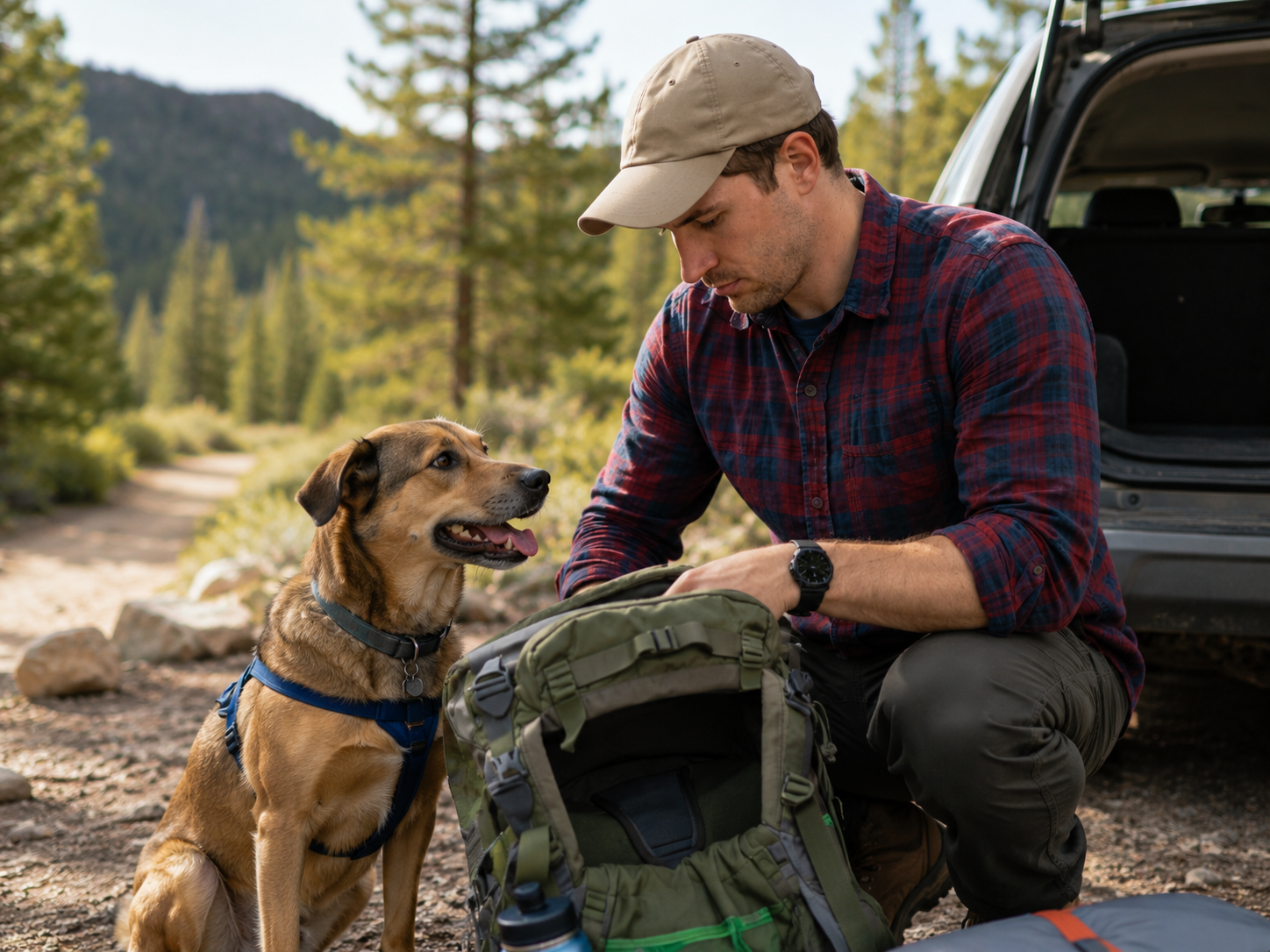
There is a familiar moment in dog backpacking planning when the simple idea starts to feel complicated.
At first, you picture the good part. Your dog trotting beside you on a quiet trail. A calm evening at camp. A morning stretch outside the tent before another day of hiking together.
Then the gear questions begin.
Should your dog wear a pack? How much should they carry? Do they need booties? What about a GPS tracker, a camp light, a sleeping pad, a rescue sling, or a special harness? Should the dog carry their own food? Should you carry the first aid kit? What happens if the pack rubs halfway through the day?
Those are not bad questions.
They are the beginning of building a safer system.
A good dog backpacking setup is not about buying every item that could possibly help. It is about choosing the right gear for your dog, your route, your weather, and your ability to respond when something changes.
Your dog is not extra gear added to your hiking plan. Your route, pace, shelter choice, water plan, food load, camp routine, first aid kit, and emergency decisions all need to account for two living beings instead of one.
We will look at what your dog should carry, what you should carry, how a dog pack should fit, and where trail tech can help without giving you false confidence.
This guide is written for beginner and early-intermediate hikers who are starting to take dog backpacking more seriously. It is not meant to turn your dog into a working pack animal. It is meant to help you build a simple, safe, and realistic gear system that supports the trip without asking too much of your dog.
This article is based on trail planning, outdoor decision-making, and practical dog-backpacking considerations. Every dog is different. Age, breed, size, health history, body condition, heat tolerance, trail fitness, and behavior all matter. Before starting a new hiking, conditioning, or backpacking routine with your dog, speak with your veterinarian.
This article contains affiliate links. If you purchase through these links, MoreHiking may earn a commission at no additional cost to you. We only recommend gear we trust and have carefully researched.
Start With the Problem, Not the Product
Dog backpacking gear can get confusing because almost every item sounds useful.
A dog pack sounds useful. So do booties, a cooling vest, a GPS tracker, a rain jacket, a sleeping pad, a camp light, a collapsible bowl, and a rescue sling.
Some of those items may be right for your dog. Some may not be needed at all. A few may only make sense for certain routes, seasons, or dogs.
The better question is not, “What gear can I buy?”
The better question is, “What problem am I trying to solve?”
Your dog’s gear should usually help with one of these needs: control, identification, food, water, rest, warmth, paw protection, waste, first aid, or emergency movement.
A harness and leash help with control. A collar tag and microchip help with identification. A bowl and food bag help with feeding. A pad or blanket helps with rest. Booties or paw balm may help with rough ground. A small light can help you see your dog at camp.
When you think this way, gear becomes easier to judge.
If an item solves a real problem for this dog, on this route, in this season, it may belong in the system. If it only looks clever but does not solve a likely trail problem, it may be extra weight.
That is the heart of a good dog backpacking gear system.
It should be simple enough to use when you are tired, wet, hungry, or trying to settle camp before dark.
Check the Rules Before You Pack
Before you decide what your dog should carry, make sure your dog is allowed to be there.
This sounds obvious, but it is one of the easiest mistakes to make. A trail may look dog-friendly online and still have limits. Some areas allow dogs only in developed areas. Some require leashes. Some restrict dogs during certain seasons. Some do not allow dogs on specific trails at all.
For a U.S. audience, this is especially important in national parks, national forests, state parks, wilderness areas, and local conservation lands. The rules are not the same everywhere.
The National Park Service advises hikers to keep dogs on a 6-foot leash where pets are allowed. It also reminds dog owners to be mindful of reactive behavior around new people, other dogs, and new spaces.
That matters because leash rules affect your gear system.
If the trail requires a leash, your leash is not optional. If the route is busy, your control setup matters more. If your dog is reactive, narrow trails and crowded camps may not be fair places to test new gear.
National forest rules can also vary by area. For example, the U.S. Forest Service notes that dogs must be on a six-foot leash in developed recreation areas and on interpretive trails in the Gifford Pinchot National Forest, while some other forest trails may have different leash rules.
The rule check should happen before the packing check.
Look up the current land manager guidance. Read the pet rules for the exact trail or area. Check leash requirements, campsite rules, wildlife warnings, and waste rules. If the rules are unclear, contact the managing agency before you go.
This protects the trip. It also protects access for other responsible dog owners.
What Should Your Dog Carry?
A dog backpack can be useful, but it can also create a bad habit.
It is easy to think, “My dog can carry their own food and gear.”
Sometimes that is true. But it is not always the best choice.
The better question is not what your dog can carry. The better question is what your dog should carry on this trip.
A healthy, conditioned dog with a well-fitted pack may be able to carry a small amount of light gear. But the dog’s load should stay conservative, especially for beginner teams.
Your dog may be able to carry a collapsible bowl, a small towel, a few waste bags, lightweight booties, or a small portion of food. These items are useful, but they are not the most important safety items.
The human should usually carry the critical gear.
That means the first aid kit, medications, emergency communication device, extra water, route information, spare leash, and anything needed if the dog becomes injured or the pack has to come off.
This is important because a dog pack is not always worn all day.
You may remove it during a hot climb. You may take it off at camp. You may remove it if it starts rubbing. You may take it off for water crossings, steep sections, or rough terrain.
If the most important items are in the dog’s pack, your system becomes weaker at the moment you need it most.
A simple rule works well:
Your dog can carry convenience items. You should carry critical items.
That keeps the emergency plan with the person who can make decisions.
How Much Weight Should a Dog Carry?
Many hikers want a number.
That is understandable. Numbers feel clear. But dog pack weight depends on more than body weight.
The main pillar article uses a conservative approach. It notes that many recreational hikers use a rough guideline of keeping a dog’s pack around 10 percent of the dog’s body weight, with higher loads only for healthy, conditioned dogs with excellent pack fit and suitable terrain. It also notes that the number should come down in heat, on rocky ground, on long-mileage days, for senior dogs, for dogs with joint concerns, and for dogs still building trail fitness.
That is a good starting point, but it should not be treated as permission to load the pack.
A 50-pound dog carrying 5 pounds may sound reasonable. But that same load can become too much on a hot day, a steep descent, sharp rock, deep mud, or a long dry stretch.
Heat is one of the biggest reasons to stay conservative. The American Veterinary Medical Association advises pet owners not to walk, run, or hike with dogs during the hottest parts of the day or on particularly warm days. It also recommends frequent breaks and enough water for both people and pets.
That advice fits backpacking very well.
If the day is hot, your dog should carry less. If the terrain is rough, your dog should carry less. If your dog is tired, stiff, young, senior, short-nosed, overweight, underconditioned, or recovering from injury, your dog should carry less.
Some dogs should not carry a pack at all.
That does not mean the dog is weak. It means you are matching the system to the dog.
A dog’s pack should serve the trip, not prove a point.
How a Dog Backpack Should Fit
A dog backpack should fit like trail gear.
It should not look loose, sloppy, or awkward. It should not slide around when your dog walks. It should not bounce, twist, sag, rub, or block normal movement.
A good pack should sit securely without restricting shoulder movement or creating rubbing under the front legs, across the chest, behind the elbows, or along the belly straps. It should not swing, sag, bounce, or twist when the dog climbs, turns, or lies down.
That is the test.
Before you start adjusting straps, it helps to know the main places to inspect. This quick fit-check graphic shows the seven areas that matter most before you head down the trail.
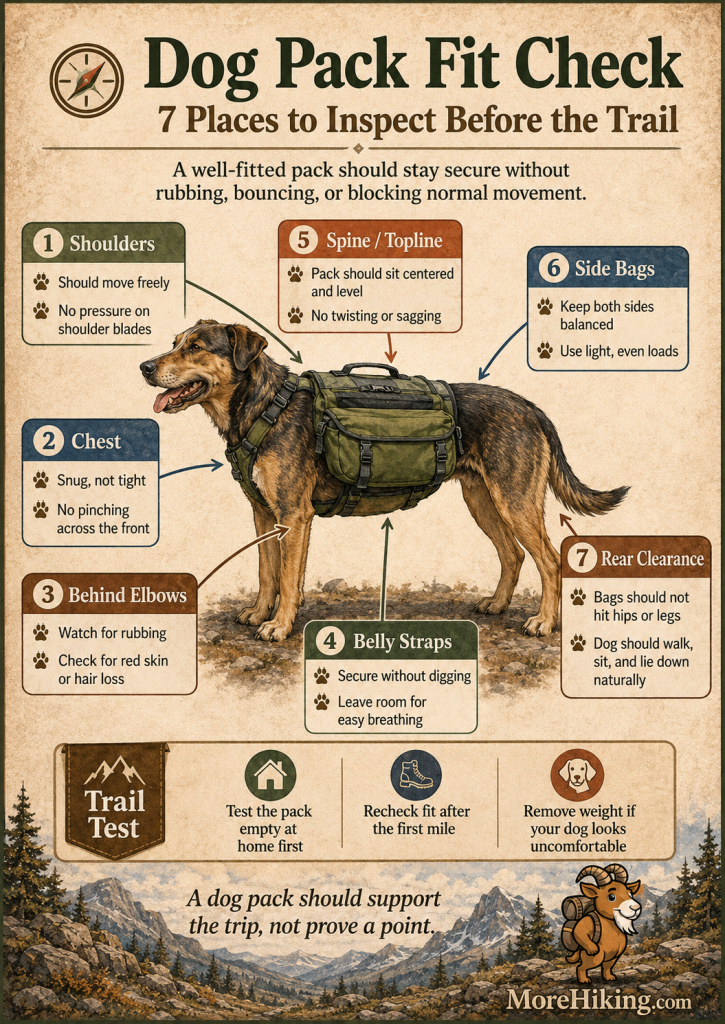
Start at home with the pack empty.
Let your dog wear it without weight first. Watch how they stand. Then have them walk across the room, turn around, sit, and lie down. If the pack looks awkward when empty, it will not improve once it is loaded.
After that quick visual check, move on to the contact points.
Look around the shoulders, chest, belly straps, behind the elbows, and along the back. Slide your fingers under the straps. They should be snug, but not tight enough to pinch or dig in.
Then go for a short walk.
Do not start with a long hike. Walk around the block. Let your dog move normally. When you get home, check again. Look for rubbing, red skin, hair loss, pressure marks, or places your dog keeps licking.
Only after the empty pack works should you add a small amount of weight.
Keep both sides balanced. Use soft items when possible. Avoid hard corners pressing into your dog’s body. Add weight slowly over time, not all at once.
The best time to learn that a pack rubs is not five miles from the trailhead.
It is on a short walk, close to home, when you can still change the plan.
Do a Pack Check During the First Mile
Even a pack that fits well at home should be checked again on trail.
The first mile tells you a lot. Your dog is moving over real ground now. The pack is shifting with turns, climbs, descents, and pauses. Straps that looked fine in the living room may start to rub once your dog is moving naturally.
Stop early and check the fit.
Look behind the front legs, under the chest, along the belly straps, and around the shoulders. Make sure the pack is still balanced. Watch whether your dog is walking normally, stopping more than usual, scratching at the pack, or trying to rub against brush or rocks.
This first check is easy to skip because the trip has just started.
But it is much better to fix a small rubbing point after ten minutes than to discover a sore spot at camp.
This is also a good time to check your expectations.
If your dog already seems uncomfortable, do not push deeper into the trail just because the plan looked good at home. Remove weight. Adjust the pack. Shorten the route if needed.
A trail-ready team leaves room to respond.
The Shakedown Walk Matters
Many hikers test their own backpack before a bigger trip. Your dog’s gear deserves the same treatment.
A shakedown walk is a short, low-risk test before the real trail day.
Use it to test the pack, harness, leash, bowl, booties, light, sleeping pad, and any other item your dog will use. The goal is not to make the walk difficult. The goal is to find problems early.
Start with the pack empty. Then try a light load. Then test it on an easy trail. Watch how your dog moves. Watch how often they stop. Notice whether they scratch at the pack, avoid sitting, walk unevenly, or seem less relaxed than usual.
Booties need their own practice.
Many dogs walk strangely in booties at first. That does not mean the booties are useless, but it does mean they should not appear for the first time on sharp rock, hot ground, snow, or ice.
Just as you should practice using your camp gear before you need to use it, your dog needs to practice too. We recommend trail conditioning gradually for best possible results.
If your dog will sleep on a pad, introduce the pad before the trip. If your dog will wear a light at camp, test the clip. If your dog will be tethered, practice calmly in a safe place.
The first overnight should not be the first time your dog sees the whole system.
A short test can save a long problem.
Trail Tech Should Support Control, Not Replace It
Trail tech can be helpful, but it should never be the reason you take a bigger risk with your dog.
A GPS tracker, dog light, satellite communicator, phone map, or saved medical record can all support a better trip. But none of them replace leash control, training, conditioning, route choice, or paying attention to your dog.
That distinction matters.
A quick visual can help here. This trail-tech guide shows which tools can be useful, when they help, and what they should never replace in your overall trail system.
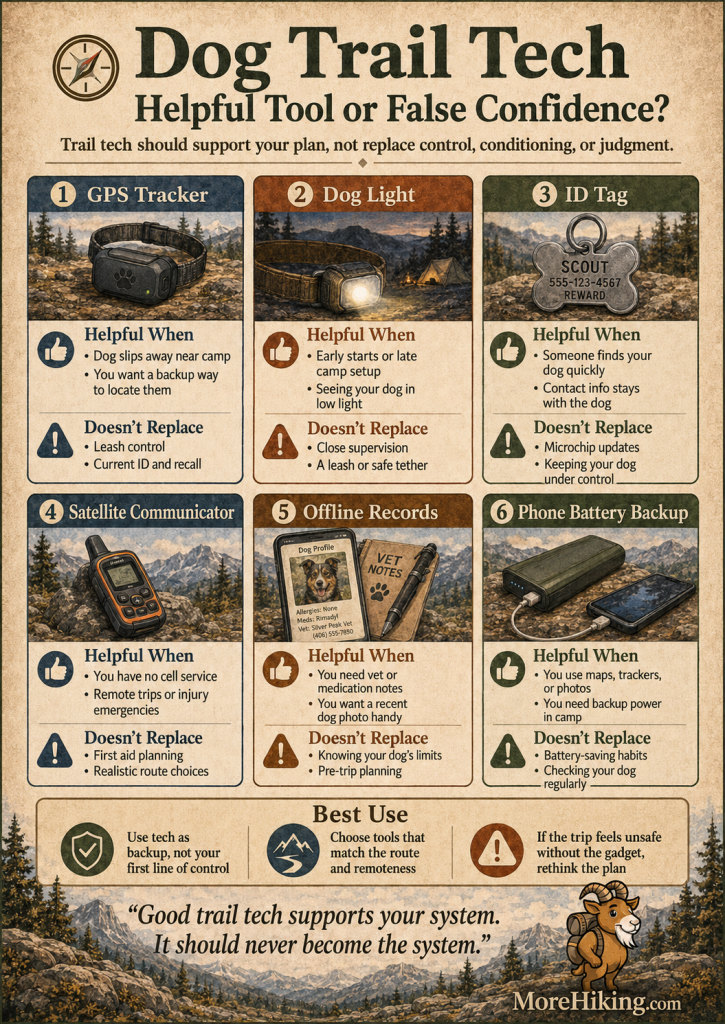
As the graphic suggests, tech is most useful when it helps you manage a problem you have already thought through. It becomes risky when it makes you feel prepared for a problem you have not actually planned for.
A GPS tracker may help you locate your dog if they slip away near camp or around a trailhead. But not every tracker works the same way. Some need cell service. Some depend on Bluetooth range. Some need a charged phone. Some are better for town and campground use than deep backcountry travel.
A tracker is a backup tool.
It is not a reason to let a dog roam.
A small dog light can be more useful than people expect. It helps you see your dog at camp, during early starts, or when you arrive late. It can also help other hikers notice your dog sooner.
A satellite communicator is mostly human gear, but it belongs in this conversation. If your dog is hurt and you have no cell service, communication may matter. This is especially true if you are hiking alone, far from a trailhead, or in an area where carrying your dog out would be difficult.
Simple digital records can also help. Keep a recent photo of your dog on your phone. Save vaccination records, medication notes, your vet’s contact information, and emergency contacts where you can access them offline.
Technology should support your plan.
Who Carries What?
This is where many dog backpacking systems become clearer.
Ask one simple question:
Would the trip become unsafe if this item was not with me?
That question makes the packing decision much easier. This simple guide shows which items can usually go in the dog’s pack and which safety items should stay with you.
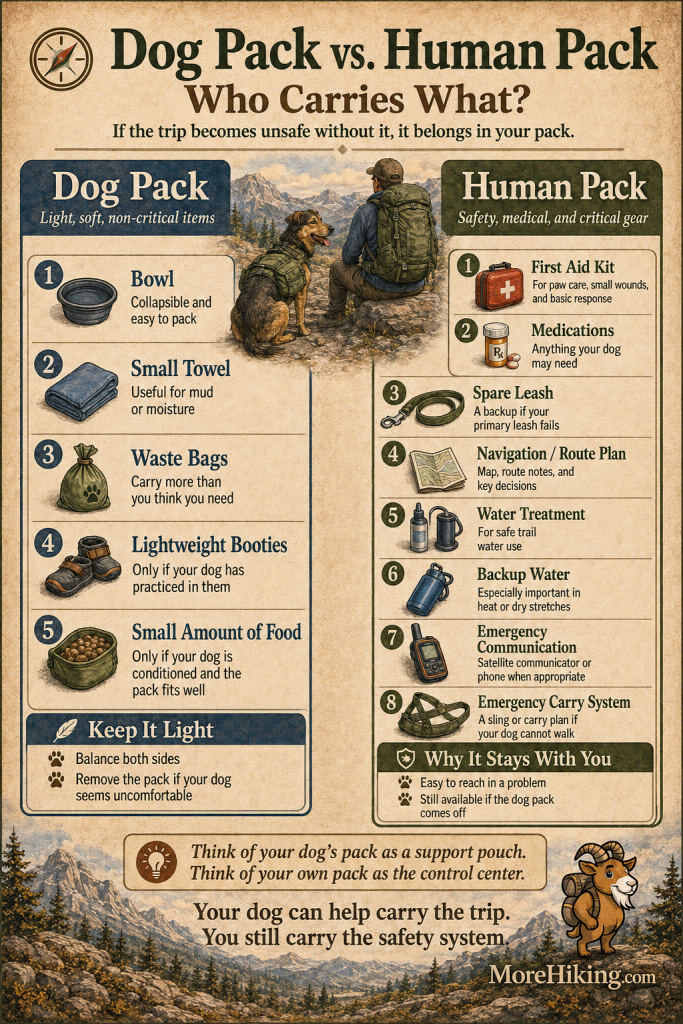
As a general rule, if the answer is yes, the item should probably be in your pack, not your dog’s pack.
Your dog may carry light, soft, non-critical items. That might include a bowl, small towel, waste bags, or a small amount of food.
You should usually carry the first aid kit, medications, spare leash, emergency communication, water treatment, backup water, route plan, and emergency carry system.
This is not about being unfair to the human.
It is about keeping the safety system stable.
If your dog starts limping, overheating, or acting strangely, you want the important supplies easy to reach. You do not want to remove and search through a dog pack while your dog is uncomfortable or stressed.
Think of your dog’s pack as a small support pouch.
First Aid Gear Is About Decisions
A first aid kit matters, but supplies are only part of the issue.
The harder part is knowing what to do when your dog starts showing signs that something is wrong.
If your dog cuts a paw, do you clean it and continue slowly? Do you rest and watch it for a while? Do you turn around? If your dog starts limping, is it a pebble between the toes, a sore pad, a torn nail, a muscle strain, or something more serious?
A blog post cannot diagnose your dog. But it can help you think more clearly before the trail puts pressure on the decision.
That is why canine first aid for hiking should be treated as a planning skill, not just a kit you toss into your pack. Your dog’s first aid setup should match common trail problems such as paw cuts, torn nails, ticks, minor wounds, overheating concerns, stomach upset, and rubbing from gear.
You should also carry anything your veterinarian recommends for your dog.
Do not guess with medication. Ask your vet what is safe, what dose is appropriate, and when it should or should not be used.
The bigger question is emergency movement.
Could you move your dog if they could not walk?
For a small dog, that may be hard but possible. For a large dog, it can become one of the biggest safety questions of the trip. A rescue sling or emergency carry harness may help, but only if you can actually use it with your dog’s size and your own strength.
This question should affect your route choice.
A short loop close to the trailhead is different from a remote ridge with limited exits. A solo hike is different from hiking with another adult. A mild forest trail is different from a rocky climb in hot weather.
The goal is not to make dog backpacking scary.
The goal is to be honest before the trail forces you to be honest.
Paw Protection Starts Before the Trip
A dog’s paws can look tough until the wrong trail proves otherwise.
Sharp rock, hot ground, abrasive gravel, frozen crust, long descents, and muddy tread can all cause problems. A worn pad, cracked nail, raw spot, or seed between the toes can change the whole day.
Paw protection is not just about buying booties.
It starts with conditioning. Your dog needs time to adapt to distance and surface. That does not mean forcing them through damage. Toughening paws and injuring paws are not the same thing.
Booties can help in the right conditions. Paw balm may help with dryness or mild abrasion. Trimmed nails can make walking more comfortable, especially on descents.
But the most important habit is checking.
Do not wait until camp. Check paws during breaks. Look between the toes, around the nails, along the pad edges, and anywhere your dog keeps licking.
If your dog starts limping, stop.
Do not assume they are being stubborn. Inspect the paw. Remove small debris if you can do it safely. Protect the area if needed. If the limp continues, turn around or shorten the route.
A small paw issue can become a big evacuation problem if you keep pushing.
Food and Water Add Weight Fast
Food and water seem simple until you have to carry them.
Dog food takes space. Water is heavy. Bowls, treats, and extras add up. This is where it becomes tempting to put more in the dog pack.
Be careful.
A dog carrying food is still carrying weight. A dog carrying water is carrying dense weight. On an easy, cool trail, a little food may be fine for a conditioned dog. On a hot climb or rough descent, the same load may become too much.
Water planning deserves extra care.
Your dog may need water before you do. Dogs are closer to the ground, may be wearing fur, and may keep moving out of excitement even when they should slow down.
Offer water before your dog looks desperate. Watch for heavy panting, slowing down, shade-seeking, unusual behavior, or reluctance to continue.
Do not rely on every stream shown on a map. Water may be dry, muddy, stagnant, difficult to reach, or unsafe. If you would not drink from a source without caution, do not assume it is fine for your dog.
Food should also be tested before the trip.
Do not introduce a new food or rich treat for the first time in the backcountry. A stomach problem at home is inconvenient. A stomach problem on a backpacking trip can become a serious issue.
If you are planning longer routes or multi-day trips, it is worth thinking through food and water for dog backpacking before you pack. Your dog’s calories, water needs, bowl setup, and backup water plan should all match the route, weather, and effort level.
At camp, treat dog food like food. Store it according to local rules. Dog food can attract wildlife just like your own food.
Waste Gear Needs a Real Plan
Dog waste is not the most exciting part of backpacking, but it matters.
On a short day hike, the system may be simple. Bag it, carry it, and throw it away at the trailhead.
On a multi-day trip, it takes more planning.
You may need to carry bagged waste for hours or even days. That is not pleasant, but leaving it behind is not acceptable. A dog waste bag beside the trail is not “coming back for it.” It is abandoned trash unless you truly retrieve it.
Leave No Trace advises pet owners to bag dog waste on the trail and put it in the trash, noting that this helps keep recreation lands clean for everyone.
Your waste system should be separate and simple.
Carry more bags than you think you need. Consider double-bagging. For longer trips, some hikers use an odor-resistant bag, a hard-sided container, or an outside waste tube attached to the pack.
Keep it away from food. Keep it secure. Make sure the system still works when you are tired or hiking in bad weather.
Responsible dog hiking includes the less glamorous parts.
That is part of keeping trails open to dogs.
Camp Is Where the System Gets Tested
Many dog gear problems show up after the walking stops.
At camp, your dog is tired but stimulated. There are new smells. Food is out. Other campers may be nearby. Wildlife may move after dark. The tent is fragile. The routine is different from home.
This is why camping with a dog deserves its own plan. Your camp setup should help your dog settle, stay warm enough, avoid damaging gear, and remain safely controlled through the night.
A simple sleeping pad can make a big difference. It gives your dog a clear place to rest. It also helps protect the tent floor and adds insulation from the ground.
If your dog sleeps inside the tent, think about claws, wet fur, muddy paws, mesh doors, and inflatable pads. Trimmed nails and a practiced “place” routine can prevent a lot of frustration.
If your dog sleeps in a vestibule or under a tarp, think carefully about warmth, rain, tether safety, wildlife, and escape risk.
Your dog’s pack should usually come off at camp. This gives the body a break and lets you check for rubbing, ticks, burrs, sore spots, and stiffness.
Look under the chest, behind the elbows, around the belly straps, and anywhere the harness or pack touched the body.
Camp is also the time to reset the system for the next day. Dry wet gear. Refill water if available. Rebalance food if your dog is carrying any. Put waste where it belongs. Charge or check tech items if needed. Keep the leash within reach.
A calm camp routine is gear, training, and habit working together.
When Your Dog Should Not Wear a Pack
Sometimes the best dog pack decision is to leave it at home.
Your dog may be better without a pack if the day is hot, the trail is rocky, the route is steep, the mileage is long, or water crossings are frequent.
A pack may also be a poor choice for a dog that is still growing, poorly conditioned, elderly, overweight, short-nosed, recovering from injury, or prone to overheating.
Do not ignore behavior changes.
If your dog slows down, keeps stopping, rubs against objects, walks unevenly, avoids sitting, or seems uncomfortable, listen. Remove the pack. Check the fit. Reduce the load. Change the plan if needed.
A dog does not need to carry gear to be a good trail partner.
The real goal is not to make your dog look trail-ready.
The goal is to keep your dog safe, comfortable, and able to recover.
A Simple Dog Backpacking Gear System
A checklist can help, but it should not replace judgment.
Use this as a starting point and adjust for your dog, route, season, weather, and veterinary advice.
Your dog should usually wear a secure harness, current ID, and a leash. A light or reflective item may help in low light or at camp.
The dog pack, if used, should carry only light, soft, non-critical items. Think bowl, small towel, waste bags, lightweight booties, or a small amount of food.
Your pack should carry the important safety items. That includes first aid, medications, water backup, spare leash, route plan, emergency communication, medical records, and any carry-out system.
For camp, think about a sleeping pad, towel, warmth layer if needed, safe tether plan, waste system, food storage, and a routine that helps your dog rest.
During the day, keep checking the dog, not just the gear.
Look at paws, pack fit, rubbing points, water intake, heat signs, appetite, movement, mood, and energy.
Those small checks are what keep small problems from becoming big ones.
Where This Fits Into the Bigger Dog Backpacking Plan
Gear matters, but gear is only one part of the trip.
Your dog still needs the right route, gradual conditioning, legal trail access, safe weather, enough water, a camp routine, first aid planning, and recovery time.
A good pack cannot fix a poor route. A GPS tracker cannot fix bad leash control. Booties cannot fix a trip that is too hot. A first aid kit cannot replace the decision to turn around.
This is why dog backpacking works best when it is built in layers.
First, decide whether the trip is fair for your dog. Then build fitness. Then choose the gear. Then test the gear. Then try a short shakedown trip. Then adjust.
That may feel slow.
But slow is often what makes the trip safer.
The parent pillar article makes the same broader point: a good multi-day dog backpacking trip is not about proving your dog can handle anything. It is about choosing a route your dog can handle well, building the right habits before you go, and paying attention closely enough to adjust when the trail gives you new information.
A trail-ready dog team is not built by buying more gear.
It is built by paying attention.
Conclusion: Good Gear Makes You a Better Trail Partner
Dog backpacking gear is easy to overbuy.
It is also easy to misunderstand.
A dog pack does not make your dog ready. A GPS tracker does not replace control. Booties do not replace paw checks. A first aid kit does not replace the decision to turn around when your dog is struggling.
But the right gear, chosen carefully and tested before the trip, can make you a better trail partner.
A well-fitted pack can help your dog carry a small amount of appropriate gear. A good harness and leash can improve control. A light can make camp easier. A sleeping pad can help your dog rest. A waste system protects the trail. A first aid and carry plan gives you options when something goes wrong.
The best dog backpacking gear system is not the biggest one.
It is the one that fits your dog, fits the route, solves real problems, and still works when the day becomes harder than expected.
Your dog does not need to carry everything.
Your dog needs you to think ahead.
That is what turns gear into a trail-ready system.
Frequently Asked Questions
How much weight should my dog carry while backpacking?
For many beginner teams, a dog’s pack should stay light. A rough recreational guideline is around 10 percent of the dog’s body weight, but that should be reduced for heat, rough ground, long mileage, senior dogs, joint concerns, poor conditioning, or any pack-fit issue.
How should a dog backpack fit?
A dog backpack should sit securely without rubbing, bouncing, twisting, sagging, or blocking shoulder movement. Test it empty first, then add a small amount of weight only after your dog moves comfortably.
What should my dog carry on a backpacking trip?
Your dog may carry light, soft, non-critical items such as a bowl, small towel, waste bags, lightweight booties, or a small amount of food. The human should carry the important safety gear.
What should I carry instead of putting in my dog’s pack?
You should usually carry the first aid kit, medications, backup water, spare leash, route plan, emergency communication, medical records, and any system needed to help move your dog if they cannot walk.
Are GPS trackers useful for hiking with dogs?
GPS trackers can be useful, but they have limits. Some need cell service, Bluetooth range, battery power, or a charged phone. A tracker should support your safety system, not replace leash control, ID tags, training, or good judgment.
Should my dog wear a pack on every hike?
No. A dog pack only makes sense when it fits well, the load is light, the dog is conditioned, and the route is suitable. On hot, steep, rocky, or long routes, it may be better for the human to carry more.
If you have enjoyed this article, please also read our other post.
Leave a Reply