
One of the most common beginner hiking questions is simple: how far should I hike?
The honest answer is that distance matters, but it is not the only thing that makes a hike feel easy or hard. A flat 3-mile trail through a local park may feel calm and comfortable. A steep 3-mile trail with rocks, roots, mud, and no shade may feel like too much.
For many beginners, a good first hike is usually somewhere around 2 to 5 miles, or about 1 to 3 hours, on a well-marked trail with modest elevation gain. But the better question is not just, “How many miles can I do?”
The better question is:
Can I finish this hike safely, calmly, and still want to hike again?
This guide will help you judge beginner hiking distance by looking at miles, time, elevation, trail surface, fitness, and weather. The goal is not to push you into a bigger hike. The goal is to help you choose the right hike for where you are right now.
If you are still deciding how to begin hiking in general, start with our full guide on how to start hiking as a complete beginner. This article focuses only on judging the right distance, time, and elevation for your early hikes.
The Simple Answer: How Far Should a Beginner Hike?
A beginner should usually start with a hike that feels manageable instead of impressive. For many people, that means choosing a trail between 2 and 5 miles, with easy footing, clear signs, and limited elevation gain.
If you are very new to walking, recovering fitness, hiking with kids, or unsure how your body will respond to uneven ground, it is better to start shorter. A 1- to 2-mile trail can still be a real hike if it helps you build confidence.
If you already walk often, exercise regularly, or feel comfortable being active for a few hours, a 3- to 5-mile beginner hike may be reasonable as long as the trail is not too steep or rough.
The infographic below gives you a quick way to judge whether a hike is the right size for you right now. Use it before choosing a trail, especially if you are comparing two hikes that look similar on paper.
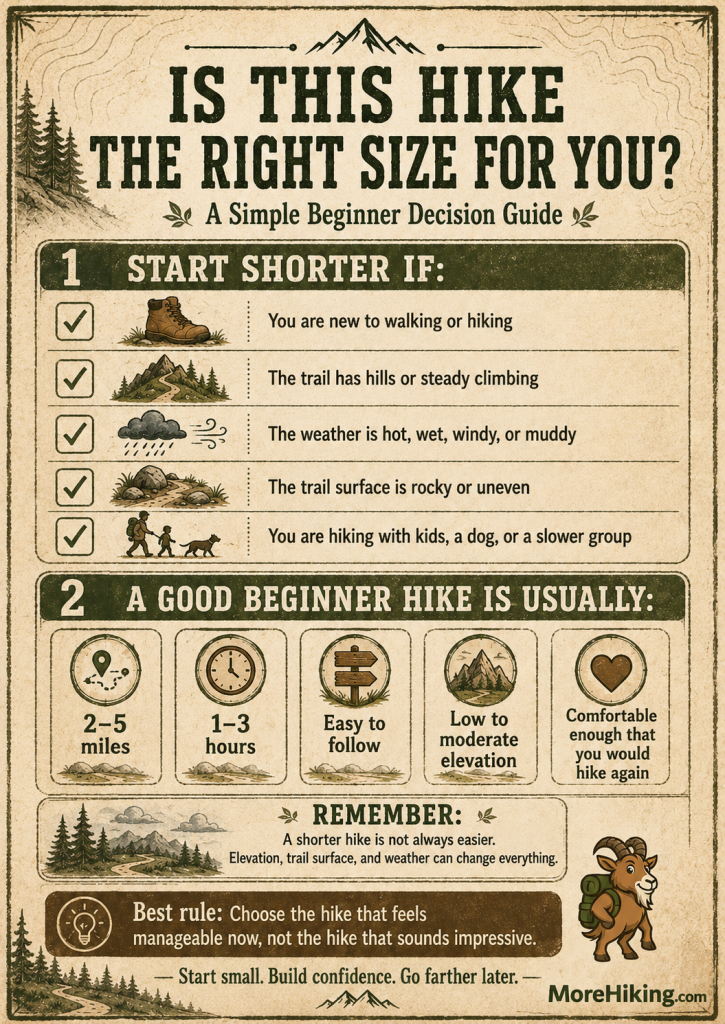
These are not strict rules. They are starting points. A beginner hike should leave you feeling tired in a healthy way, not overwhelmed, rushed, or discouraged.
If the hike has hills, rough footing, difficult weather, or a slower group pace, choose the shorter option. A hike does not have to sound impressive to be the right choice.
Why Mileage Alone Can Be Misleading
Many beginners choose a hike by looking at mileage first. That makes sense, but mileage can be misleading. Clear signs and an easy-to-follow route also matter, especially while you are still building your beginner hiking navigation skills.
Two hikes can both be 3 miles and feel completely different.
One trail may be flat, wide, shaded, and smooth. Another may climb steadily, cross rocks and roots, and leave you exposed to sun or wind. On paper, both trails may look short. On your legs, they will not feel the same.
That is why beginner hikers should look at the whole hike, not just the distance.
Before choosing a trail, pay attention to:
- Total distance
- Estimated hiking time
- Elevation gain
- Trail surface
- Weather
- Shade or exposure
- How clearly the trail is marked
- Your current fitness and energy level
A short hike is not automatically easy. A longer hike is not automatically too hard. The right hike depends on how all these factors fit together.
This is also why two beginners may need different starting points. One person may feel great on a 4-mile trail. Another may be better served by a 2-mile trail. Both choices can be right when they match the hiker’s current ability.
Think in Time, Not Just Distance
A beginner hike often takes longer than a normal walk around the neighborhood. Trails slow you down because you may be stepping over roots, climbing hills, stopping for water, checking signs, taking photos, or walking carefully downhill.
That is why it helps to think in terms of time and effort, not only distance.
For a first or early hike, many beginners do best with a route that takes about 1 to 3 hours. That gives you enough time to feel like you went hiking without turning the day into a test.
| Trail Distance | Beginner Time Estimate | What to Remember |
|---|---|---|
| 1–2 miles | 30–90 minutes | Good for a first trail experience |
| 2–4 miles | 1–2.5 hours | A solid beginner range for many hikers |
| 3–5 miles with hills | 2–4 hours | More challenging if elevation is steady |
| Rough or steep trail | Add extra time | Footing can slow you down more than expected |
If you are unsure, choose the shorter option. A hike that ends with extra energy is better than a hike that becomes stressful halfway through.
This article is not meant to fully cover hiking pace, but pace does affect how far a beginner should hike. If you often start too fast and feel tired early, it may help to learn how to pace yourself on a hike before choosing longer trails. For now, give yourself more time than you think you need, especially while you are still learning how trails feel.
Elevation Gain: The Part Beginners Often Underestimate
Elevation gain means how much climbing you do during the hike. It is one of the biggest reasons a short hike can feel hard.
A 2-mile flat trail may feel easy. A 2-mile trail that climbs steadily may feel much harder, especially if you are not used to uphill walking.
For beginner hikers, elevation gain is often more important than distance. A short trail with a steep climb may be more tiring than a longer trail that stays mostly flat.
| Elevation Gain | Beginner Meaning | Best Use |
|---|---|---|
| 0–300 feet | Very beginner-friendly | Good first hike range |
| 300–700 feet | Manageable for many beginners | Good once you are comfortable on easy trails |
| 700–1,000 feet | More challenging | Better after a few successful hikes |
| 1,000+ feet | Usually not ideal for a first hike | Save for when your pacing and trail comfort improve |
This does not mean beginners can never hike a trail with 1,000 feet of elevation gain. Some active beginners may handle it well. But if you are new to hiking, it is smarter to start with shorter hikes and build gradually instead of choosing a steep trail too early. American Hiking Society reminds beginners that 1,000 feet of elevation gain may feel easy for some hikers and very challenging for others, so the right hike depends on your current ability.
Elevation is personal. It depends on your fitness, your pace, the weather, the trail surface, and how much hiking experience you already have.
Trail Surface Can Make a Short Hike Feel Long
Distance is easier to judge when the trail surface is smooth. It becomes harder to judge when the trail is rough.
A beginner may be able to walk 4 miles on a paved path but feel tired after 2 miles on a rocky trail. That does not mean anything is wrong. It simply means the trail asked more from your feet, ankles, knees, balance, and attention.
Distance is only one part of trail difficulty. Elevation, footing, weather, and fatigue all affect what makes a hike hard.
| Trail Surface | How It Feels for Beginners | Distance Advice |
|---|---|---|
| Paved or boardwalk | Usually easiest | You may handle more distance |
| Packed dirt or gravel | Beginner-friendly | Good for early hikes |
| Roots and rocks | Slower and more tiring | Choose a shorter route |
| Mud or sand | Uses more energy | Reduce distance |
| Snow or ice | Much slower and higher risk | Not ideal for most first hikes |
If a trail description mentions rocks, roots, loose gravel, mud, steep stairs, scrambling, or washed-out sections, treat the hike as harder than the mileage suggests.
A smooth 4-mile trail may be a better beginner choice than a rough 2.5-mile trail with steep climbs and poor footing.
Weather Can Change the Right Hiking Distance
The same trail can feel easy in mild weather and much harder in heat, cold, rain, wind, or humidity.
Hot weather can make a short hike feel longer because your body works harder to stay cool. Cold rain can drain energy and make rest stops uncomfortable. Wind can make exposed trails feel more tiring. Mud can slow your pace and make every step take more effort.
In cold, windy, or wet conditions, your clothing system matters too, especially if you are still learning the 3-layer hiking system.
Before choosing your distance, check the forecast and trail conditions. The National Park Service’s Hike Smart guidance recommends planning ahead, checking park alerts, watching the weather, and having a backup plan before you head out. For beginners, that may mean choosing a shorter hike when conditions are hot, wet, windy, muddy, or uncertain.
For beginners, bad weather is a good reason to reduce distance. That does not mean canceling every time the forecast is not perfect. It means being honest about how weather changes your energy, speed, and comfort.
A 5-mile hike may be fine on a cool, dry day. That same 5-mile hike may be too much in high heat, heavy rain, or muddy trail conditions.
This is also where beginner judgment starts to grow. You are not only asking, “Can I hike 5 miles?” You are asking, “Can I hike 5 miles in these conditions?”
Beginner Fitness: Choose the Hike for Your Body Today
Beginner hikers do not all start from the same place.
Some beginners already walk every day, go to the gym, bike, run, or work active jobs. Others are starting from a quieter fitness level. Both can become hikers, but they should not choose the same first trail.
A good beginner hike should match your current body, not your future goal.
Before choosing a trail, ask yourself:
- Can I walk for the expected time on flat ground?
- Can I walk uphill without needing to stop every few steps?
- Do my knees, feet, or back usually hurt after longer walks?
- Am I hiking with kids, a dog, or a slower group member?
- Will I be carrying extra weight in a backpack?
- Do I have enough daylight to move slowly if needed?
If the answers make you uncertain, choose the shorter trail. There is no prize for making your first few hikes harder than they need to be.
The goal is to finish with confidence. You can always add more distance later.
How to Choose Between Two Beginner Hikes
If you are comparing two trails, do not only choose the one with the better view. Choose the one that gives you the best chance of having a good first experience.
Here is a simple example:
| Trail Option | Distance | Elevation | Better Beginner Choice? |
|---|---|---|---|
| Trail A | 4 miles | 150 feet | Likely easier if the surface is good |
| Trail B | 2.5 miles | 900 feet | Likely harder because of the climb |
This is a good example of the rule from earlier: distance matters, but elevation can change the whole hike.
If you are new, a slightly longer flat trail may feel better than a shorter steep trail. Once you build comfort, you can begin adding more elevation.
When comparing trails, look for the combination of distance, elevation, surface, and conditions. The best beginner choice is usually the trail that gives you a little challenge without forcing you to struggle.
When Should You Repeat a Similar Trail Before Going Farther?
Progress does not always mean choosing a longer trail next time. Sometimes the best next step is to repeat a similar hike and feel better doing it.
Repeating a trail is not falling behind. It is one of the best ways to build hiking confidence.
Repeat a similar trail before going farther if:
- You were very sore after your last hike
- You felt rushed near the end
- You ran low on water or snacks
- The climb felt harder than expected
- Your feet, knees, or back hurt early
- You barely finished before dark
- You felt nervous about the route
- You finished but did not enjoy the last part
If a 3-mile trail felt difficult, repeat a 3-mile trail before moving to 5 miles. If 500 feet of elevation felt hard, try a similar climb again before choosing 900 or 1,000 feet.
Confidence grows when your body and your judgment improve together.
A Simple Beginner Hiking Progression
You do not need a complicated training plan to build hiking distance. You just need to add difficulty slowly.
The safest progression is to change one major thing at a time. Add a little more distance, or add a little more elevation, or try a slightly rougher trail surface. Do not increase everything at once.
The infographic below gives you a simple way to build from your first easy hike toward longer trails without rushing the process.
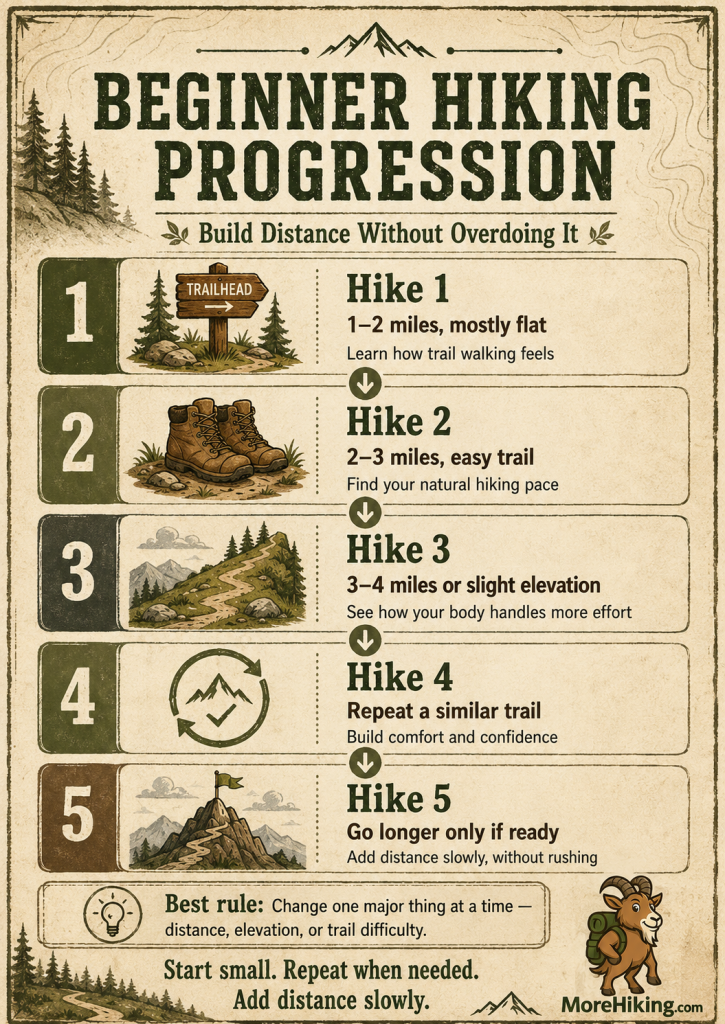
Use the distances as flexible starting points, not strict rules. If one stage feels hard, repeat a similar trail before moving on. Repeating a hike is still progress because you are building comfort, pace, and confidence.
The important part is to build slowly. If your first hike goes well, you do not have to double the distance next time. A small increase is enough.
For example, moving from 2 miles to 3 miles is progress. Repeating a 3-mile trail with more comfort is also progress. Choosing a similar distance with a little more elevation is progress too.
Signs a Hike May Be Too Far for Right Now
Sometimes a hike looks fine at the start but becomes too much once you are on the trail. That can happen because of heat, hills, rough footing, poor sleep, low energy, or a slower pace than expected.
A hike may be too far for right now if:
- You are tired before reaching the halfway point
- You are moving much slower than planned
- You are worried about daylight
- Your water is running low
- Your feet, knees, or back hurt early
- The weather is getting worse
- The trail is rougher than expected
- You feel pressure to reach the end even though the hike no longer feels good
Turning around early is not failure. It is good trail judgment.
If you also feel unsure about the route, slow down before stress leads to rushed decisions. MoreHiking explains this pattern in the Wrong Turn Spiral.
Beginners often think success means reaching the viewpoint, waterfall, lake, or summit. But a better definition is this:
A successful beginner hike is one you complete safely, learn from, and feel willing to try again.
This article is not meant to fully cover when to turn around on a hike. That deserves its own guide. For now, remember this: if the hike stops feeling manageable, it is okay to change the plan.
When distance, weather, pain, or daylight become a concern, it helps to know when to turn around on a day hike.
So, How Far Should Your First Hike Be?
If you want a simple starting point, choose a hike that is:
- About 2 to 5 miles, depending on your current fitness
- About 1 to 3 hours long
- Low to moderate in elevation gain
- Easy to follow
- On a surface you can walk comfortably
- Shorter if the weather is hot, cold, wet, muddy, or windy
If you are unsure between two hikes, choose the shorter or easier one. That first successful hike will teach you more than an overly ambitious hike that leaves you exhausted or discouraged.
There is nothing wrong with starting small. Small hikes build the judgment, pace, and confidence that make bigger hikes possible later.
Final Thoughts
The right beginner hiking distance is not about proving yourself. It is about choosing a trail that fits your current ability, the conditions, and the time you have available.
For many beginners, a 2- to 5-mile hike on an easy trail is a strong starting point. But distance is only part of the decision. Elevation, trail surface, weather, pace, and your current fitness all matter.
Start with a hike you can finish with energy left. Repeat similar trails until they feel comfortable. Then add more distance or elevation slowly.
That is how beginner hikers become safer, calmer, and more capable on the trail.
Frequently Asked Questions
How far should a beginner hike the first time?
Many beginners should start with a hike between 2 and 5 miles, depending on fitness, trail surface, elevation, and weather. If you are very new to walking or unsure about your fitness, a 1- to 2-mile trail is a smart first step.
Is 5 miles too long for a beginner hike?
Five miles may be fine for an active beginner on an easy, well-marked trail with modest elevation. But it may be too much if the trail is steep, rocky, hot, muddy, or unfamiliar. Beginners should judge the whole hike, not just the mileage.
How long should a 3-mile beginner hike take?
A 3-mile beginner hike may take about 1 to 2 hours on an easy trail, but it can take longer with hills, rough footing, rest breaks, or photo stops. Beginners should leave extra time and avoid rushing.
How much elevation gain is good for a beginner hike?
For a first hike, 0 to 300 feet of elevation gain is usually very beginner-friendly. Many beginners can handle 300 to 700 feet after a few easy hikes. A trail with 1,000 feet or more of elevation gain may be better after you have more hiking experience.
Should beginners repeat the same trail before hiking farther?
Yes. Repeating a similar trail is a good way to build confidence. If your last hike felt difficult, left you very sore, or took longer than expected, repeat a similar distance before adding more miles or elevation.
Leave a Reply