

The first time you plan food for a multi-day hike, you probably focus on the obvious question: How many calories do I need?
That’s reasonable. Hiking burns energy. You don’t want to bonk (refers to a lack of calories or hydration making it difficult to go on) halfway up a climb.
But somewhere between packing three granola bars “just in case” and stuffing in an extra loaf of tortillas because they feel light in your hand, something subtle happens. Your food bag grows. And when you shoulder your pack the next morning, it feels heavier than it should.
The issue usually isn’t that you brought too much food. It’s that you brought food that doesn’t deliver enough energy for its weight. That’s where calories per ounce changes everything.
This article isn’t about recommending specific brands. It’s about teaching you how to think through food efficiency yourself, so you can stand in any grocery store aisle or scroll through any freeze-dried meal page and know exactly what you’re looking at. If you can divide two numbers, you can do this and understand the chloric density of the foods you chose. And once you understand it, your pack weight starts dropping in ways that don’t feel like sacrifice.
This article contains affiliate links. If you purchase through these links, MoreHiking may earn a commission at no additional cost to you. We only recommend gear we trust and have carefully researched.
Why Calories Per Ounce Matters on Trail
When you’re hiking for several days, food becomes one of the heaviest categories in your pack. Shelter is constant. Clothing is mostly fixed. But food scales directly with trip length.
For a three-day trip, you might carry three to five pounds of food. For a week, it could be eight to ten pounds. That’s significant.
Now imagine two hikers both carrying 9,000 calories for a three-day trip. One carries 4.5 pounds of food. The other carries 3.5 pounds. They both eat the same number of calories. But one is carrying an extra pound the entire way. That difference often comes down to calorie density.
Calories per ounce simply measures how much energy you are carrying for each ounce of food weight. It answers the question: How efficiently is my food converting weight into usable energy?
If a food provides 150 calories per ounce, every ounce you carry gives you 150 calories of fuel. If another provides 200 calories per ounce, that same ounce gives you significantly more energy. Over days, that difference compounds.
This is not about extreme ultralight strategies or pouring olive oil on everything you eat. It’s about understanding the ratio so you can make informed decisions.
What “Calories Per Ounce” Actually Means
At its core, calories per ounce is a simple division problem. You take the total calories in the food and divide by the total weight in ounces.
Calories per ounce = Total Calories ÷ Total Weight (in ounces)
If a pouch contains 710 calories and weighs 3.7 ounces dry, you divide 710 by 3.7. The result is about 192 calories per ounce. That number this formula provides is the food’s energy efficiency per ounce of weight.
It’s important to emphasize that we use total package calories, not calories per serving. Many hikers make the mistake of reading “350 calories per serving” and stopping there. If the pouch contains two servings, the true total is 700 calories. You always want the full amount you will realistically eat.
Another important detail is that weight must be measured in ounces. Many nutrition labels list weight in grams. That’s not a problem. One ounce equals 28.35 grams. If a pouch weighs 105 grams, divide 105 by 28.35 and you’ll get approximately 3.7 ounces. Now you can calculate properly.
The concept is straightforward, but the discipline of actually checking every item is what separates efficient packing from guesswork.
How to Read a Nutrition Label for Backpacking
If you’ve never analyzed a nutrition label before, don’t worry. You’re not looking for anything complicated.
Turn the package over. Slow down. Ignore the front marketing claims. Focus only on three pieces of information.
First, look for the serving size and servings per container. These two numbers work together. If it says “Servings per container: 2” and “Calories per serving: 350,” that means the entire package contains 700 calories. Most backpackers will eat the entire pouch in one sitting, so that full number matters.
Second, find the total weight. It may say “Net Wt. 3.7 oz (105 g).” That is the dry weight if it’s a freeze-dried meal. If it only lists grams, convert to ounces as described earlier.
Third, confirm whether the weight listed is dry or prepared. Freeze-dried meals often tell you to add water. The added water increases meal volume, but it does not add calories. The efficiency calculation should always use dry weight only. Water weight does not count toward calorie density because you are not carrying it as food.
As you practice this process, it becomes intuitive. You begin to see packaging differently. Instead of asking whether a meal sounds tasty, you begin asking what it actually delivers.
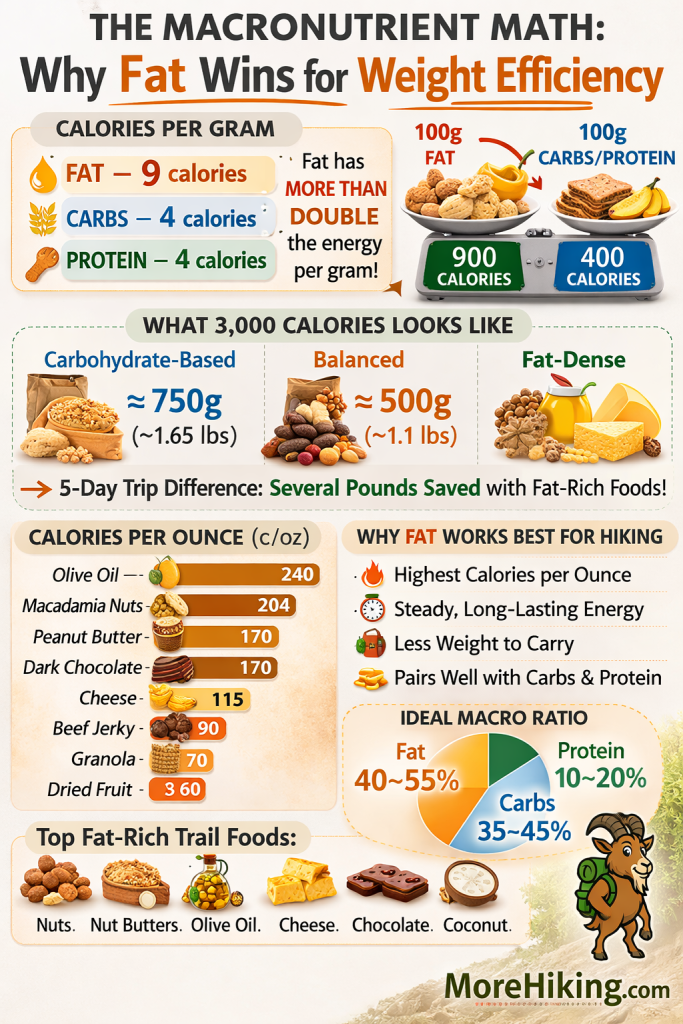
The Macronutrient Math: Why Fat Wins for Weight Efficiency
Once you understand calories per ounce, the next logical question is why some foods consistently rank higher than others. The answer lies in macronutrients.
- Fat contains 9 calories per gram.
- Carbohydrates contain 4 calories per gram.
- Protein contains 4 calories per gram.
That means gram for gram, fat provides more than twice the energy of carbohydrates or protein.
This is why foods rich in fat often dominate calorie-dense lists. Peanut butter, nuts, chocolate, and olive oil all derive a large percentage of their calories from fat.
That does not mean carbohydrates are unimportant. In fact, carbohydrates play a critical role in fueling high-intensity efforts like steep climbs or long mileage days. They replenish glycogen stores and provide quick energy.
Protein also matters for muscle repair, especially on multi-day trips.
But from a strictly weight-to-energy perspective, fat is unmatched.
If you compare two foods of equal weight, the one with a higher fat content will almost always provide more calories. This is not a license to eat recklessly. It is simply understanding how biology translates into pack weight. When you intentionally incorporate fat-dense foods, you increase efficiency without increasing bulk.
For many hikers, a practical approach is to allow fats to contribute roughly forty to fifty percent of total daily calories, carbohydrates around thirty-five to forty-five percent, and protein around fifteen to twenty percent. That balance supports energy, recovery, and weight efficiency simultaneously.
A Practical Comparison: What Efficiency Looks Like
To make this tangible, consider the following examples.
| Food Item | Total Calories | Dry Weight (oz) | Calories per Ounce |
|---|---|---|---|
| Olive Oil (1 oz) | 240 | 1.0 | 240 |
| Peanut Butter | 190 | 1.1 | 173 |
| Freeze-Dried Meal (710 cal pouch) | 710 | 3.7 | 192 |
| Trail Mix | 160 | 1.0 | 160 |
| Energy Bar | 250 | 2.1 | 119 |
| Instant Oatmeal | 160 | 1.5 | 106 |
Notice the spread.
Olive oil delivers exceptional efficiency. Energy bars, which many beginners rely on heavily, are comparatively inefficient. Oatmeal is filling and comforting, but not particularly energy dense.
None of these foods are “bad.” The lesson is about balance. If your entire food bag averages 110 calories per ounce, your pack will be heavier than it needs to be. If you intentionally incorporate higher-density items, your overall average rises, and your food weight drops.
Walking Through a Real 3-Day Example
Let’s apply this to a beginner-friendly scenario.
Imagine you’re planning a three-day hike with moderate elevation gain. You expect to burn roughly 2,800 to 3,200 calories per day. To stay safe and energized, you aim for 3,000 calories daily. Over three days, that’s 9,000 calories total.
Now suppose your chosen foods average 150 calories per ounce. To find the total weight, divide 9,000 by 150. You get 60 ounces, or 3.75 pounds.
If instead your food averages 180 calories per ounce, divide 9,000 by 180. That equals 50 ounces, or just over 3.1 pounds.
That difference is roughly 11 ounces — almost three-quarters of a pound — saved purely through smarter selection.
You didn’t eat less. You simply chose more efficient fuel. When you carry that difference uphill, you will feel it.
What Is a Good Target for Beginners?
If you are new to calorie density, do not aim for perfection immediately.
A practical beginner target is an overall average between 150 and 170 calories per ounce. That range balances efficiency with variety and satisfaction.
As you gain experience, you may push toward 180 or higher for shorter, more aggressive trips.
Anything below 120 calories per ounce on average usually indicates excess bulk or low-density foods dominating your menu.
Remember, the goal is not to eliminate foods you enjoy. It is to understand their tradeoffs.
Common Beginner Mistakes (and Why They Happen)
Most beginners overpack carbohydrates because those foods feel “light” in hand. Crackers, bread, tortillas, and granola bars don’t seem heavy individually. But calorie for calorie, they require more volume and more weight.
Another common mistake is underestimating total daily calorie needs. Hiking with elevation gain burns more energy than casual daily activity. If you pack insufficient calories, you may feel sluggish by day two.
A third issue is misreading labels. Serving sizes are often smaller than expected. If you assume a pouch contains 350 calories when it actually contains 700, your planning will be off significantly.
These are not intelligence problems. They are experience problems. And they are easily corrected once you understand the math.
Building Confidence Through Practice
The best way to internalize calorie density is to practice at home. Take five items from your pantry. Calculate calories per ounce for each. Write the numbers down. Compare them.
You will start seeing patterns. High-fat foods rise to the top. Low-fat, high-water foods fall to the bottom.
From there, build a sample one-day menu and calculate its average. Adjust. Experiment. Swap one item and see how the numbers change. This process builds confidence. Instead of copying someone else’s packing list, you develop your own understanding.
And once you understand it, you are free. You can shop anywhere. You can adapt to any resupply point. You can evaluate freeze-dried meals at CampingSurvival or any other retailer with clarity.
Don’t just hike—be prepared. Shop Camping Survival.
You are no longer guessing. You are calculating.
And when your pack feels balanced and manageable on the third day of a trip, you will know exactly why.
Frequently Asked Questions: Backpacking Calorie Density
How many calories per ounce is considered good for backpacking food?
A practical target for most beginners is an overall food bag average of about 150 to 170 calories per ounce. That range usually gives you a good balance of energy, pack efficiency, and food variety. As hikers gain more experience, some aim for 180 calories per ounce or higher, especially on shorter or more weight-conscious trips.
Should every food I pack be high in calorie density?
No. The goal is not for every single item to be extremely calorie-dense. The real goal is for your overall daily food plan to average out efficiently. Some foods, like oatmeal or certain snack bars, may be less calorie-dense but still make sense because they are comforting, familiar, or easy to eat. What matters most is the total balance of your food bag.
Why are fatty foods usually more calorie-dense?
Fat contains 9 calories per gram, while carbohydrates and protein each contain 4 calories per gram. Because of that, foods higher in fat often provide much more energy for the same carried weight. That is why items like nuts, peanut butter, chocolate, and olive oil often rank so well when backpackers calculate calories per ounce.
Does water added to freeze-dried meals count in calorie density?
No. When you calculate calories per ounce for backpacking food, you should use the dry weight only. The water you add to prepare the meal increases volume, but it does not add calories. Since you are not carrying that added water as food weight, it should not be part of the calorie-density calculation.
Is calorie density more important than nutrition on a multi-day hike?
Not exactly. Calorie density is important because it helps reduce pack weight, but it should not be your only consideration. You still want a mix of foods that supports steady energy, recovery, satisfaction, and digestion. A smart backpacking menu usually balances calorie efficiency with enough carbohydrates for effort, protein for recovery, and fats for long-lasting energy.
Can a food be lightweight but still be inefficient for backpacking?
Yes, and that is one of the most common beginner mistakes. Some foods feel light in your hand, but they do not deliver many calories for their weight. Crackers, bread products, and some snack bars can fall into this category. They are not necessarily bad choices, but if too many of them dominate your food bag, your overall calorie density drops and your pack becomes heavier than it needs to be.
What is the easiest way to calculate calories per ounce?
Use this simple formula: Calories per ounce = Total calories ÷ Total weight in ounces. For example, if a food has 600 total calories and weighs 4 ounces, it provides 150 calories per ounce. Always calculate using the full package calories, not just one serving, if you expect to eat the entire item.
What is a good calorie-density strategy for beginner backpackers?
A good beginner strategy is to start with foods you already know you enjoy, then improve efficiency by mixing in a few higher-density items. Instead of trying to make every food perfect, focus on raising the average. That usually means keeping some comfort foods while adding calorie-dense options like nut butters, trail mix, denser freeze-dried meals, or other fat-rich snacks that do not add much extra weight.
If you have enjoyed this post, perhaps you would like one of our other Posts.
Fuel Without the Bulk: Choosing the Best Calorie-Dense Foods for Multi-Day Hiking





Leave a Reply